Google Project Genie: Use A Prompt To Build A World
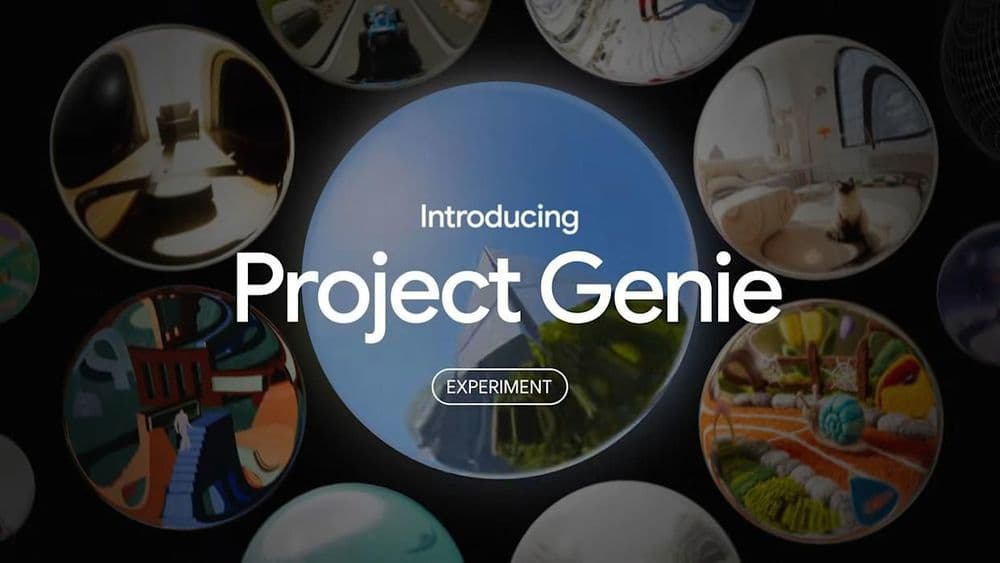
DeepMind has launched ProjectGenie, an experimental AI tool that generates interactive 3D worlds from simple text prompts. The announcement immediately impacted the gaming industry and triggered strong market reactions. Stock prices of several major game companies dropped sharply within hours, fueling concerns that AI-generated worlds could disrupt traditional game development.
In reality, ProjectGenie is a technologicalprototype that demonstrates progress in AI world modeling while exposing clear limitations. The tool is currently available only to Google AI Ultra subscribers in the United States at a monthly cost of $249.99. Each session is limited to 60 seconds, after which visual consistency begins to degrade.
Project Genie is powered by Genie 3, a real-time world model designed to generate explorable environments instead of pre-rendered videos. Unlike standard video generation tools, the system allows users to move freely through a scene as it is being generated. Users begin by entering a text prompt or uploading an image. A description such as a medieval castle during a thunderstorm is enough to produce an initial environment preview. Before entering the world, users can adjust perspective, camera behavior, and movement style.
As exploration begins, the system generates terrain and structures dynamically in the direction of movement. The experience runs at approximately 20 to 24 frames per second in 720p resolution. Basic physics and interactions are simulated in real time. Recently visited areas remain visually consistent for up to one minute due to a short-term memory mechanism.
Interaction and Creative Use Cases
ProjectGenie allows users to modify environments by refining prompts during or between sessions. Worlds created by others can be explored and expanded upon, enabling collaborative experimentation. Users can also export short videos of their sessions for sharing.
Google presents this system as an early step toward more capable AI agents that can reason, interact with environments, and support applications beyond gaming, including education, robotics training, and creative media. The company positions Project Genie as part of its broader AGI research, where world models help train AI systems to understand physical environments and predict how actions affect them.
Key Limitations of Project Genie
Despite its technical appeal, Project Genie has several constraints that prevent it from functioning as a true game development platform.
Each session lasts only 60 seconds, which is the maximum duration the system can maintain coherent visuals. Beyond this limit, environments lose stability and internal logic. This restriction makes long-form gameplay or extended exploration impossible.
Project Genie generates spaces rather than structured games. There are no objectives, progression systems, quests, or multiplayer functionality. Sessions do not persist, and nothing carries over between runs. Core aspects of game development such as balancing, narrative design, and long-term progression remain entirely manual.
Movement and interaction often feel imprecise when compared to polished commercial titles. Physics behavior can change unexpectedly, breaking immersion. Prompt accuracy also varies, and real-world locations cannot be reproduced with precision.
Why Project Genie Does Not Replace Game Development
Games rely on consistent, repeatable systems that players can learn and master. Project Genie produces probabilistic outputs that vary slightly with each generation. This variability makes it unsuitable for building reliable mechanics or competitive gameplay.
Successful games also require cohesive vision, emotional engagement, and deliberate design. AI-generated environments lack narrative intent and cultural context. While AI can assist with visual generation, it cannot independently design meaningful experiences or long-term engagement loops.
Modern games depend on tightly integrated systems including combat, progression, networking, and monetization. These systems require extensive testing, optimization, and iteration across platforms. Project Genie does not address these challenges and is best understood as an ideation tool rather than a production solution.
How AI Is Used in Game Development Today
AI already plays a practical role in modern game production when used as a supporting tool. Developers use AI to accelerate asset creation, including textures, concept art, and 3D models. Human artists refine these outputs and maintain creative direction.
Animation pipelines benefit from AI-assisted motion generation and cleanup, reducing production time while preserving artistic control. Procedural generation systems enable large-scale environments, but designers still define rules, aesthetics, and quality thresholds.
AI tools also help teams prototype ideas faster. Concepts that once required months of development can now be tested in days. AI-driven testing can identify bugs and edge cases, while human testers evaluate whether gameplay feels engaging and fair.
What Project Genie Signals for the Future of Gaming
Project Genie demonstrates progress in real-time AI world generation while highlighting current technical limits. In the near term, similar tools may prove useful during early pre-production phases, allowing designers to visualize ideas quickly or support presentations and pitches.
Even as stability and session length improve, the core challenges of game development remain unchanged. Gameplaydesign, emotionalstorytelling, and playerexperience still depend on humanjudgmentandcreativity. Studios that succeed will integrate AI selectively, using it to accelerate workflows without surrendering creative control.
404-GEN (SN17): Decentralized 3D Asset Generation on Bittensor
While Project Genie focuses on generating short explorable environments, other approaches to AI-assisted content creation exist within the decentralized space. One example is 404-GEN, which operates as Subnet 17 on the Bittensor network.
404-GEN takes a narrower focus than Project Genie. Instead of generating entire worlds, the subnet specializes in producing individual 3D assets from text prompts. Users describe an object they need, the decentralized network of miners generates candidates using techniques like Gaussian Splatting and Neural Radiance Fields, and the best output is selected through a competitive evaluation process.
Thesubnet has developed integrations with existing developer tools. A plugin is available through the Unity Asset Store, making it the first decentralized 3D generation solution to achieve Unity Verified Solution status. Additional tools include a Blender add-on and a Discord bot for quick asset generation.
The team behind 404-GEN, led by founder BenJames, has background in VFX and gaming industries. They have worked with studios including Square Enix and Parallel on AI-driven asset pipelines. The subnet currently operates at full validator capacity, with ongoing development focused on improving generation quality through competitive incentive mechanisms.
For context within the Bittensor ecosystem, 404-GEN represents a subnet delivering measurable utility in a specific domain. The focus is on reducing friction in asset production workflows rather than replacing creative roles entirely.