Bittensor Ideathon: Africa's Winning Subnet Ideas
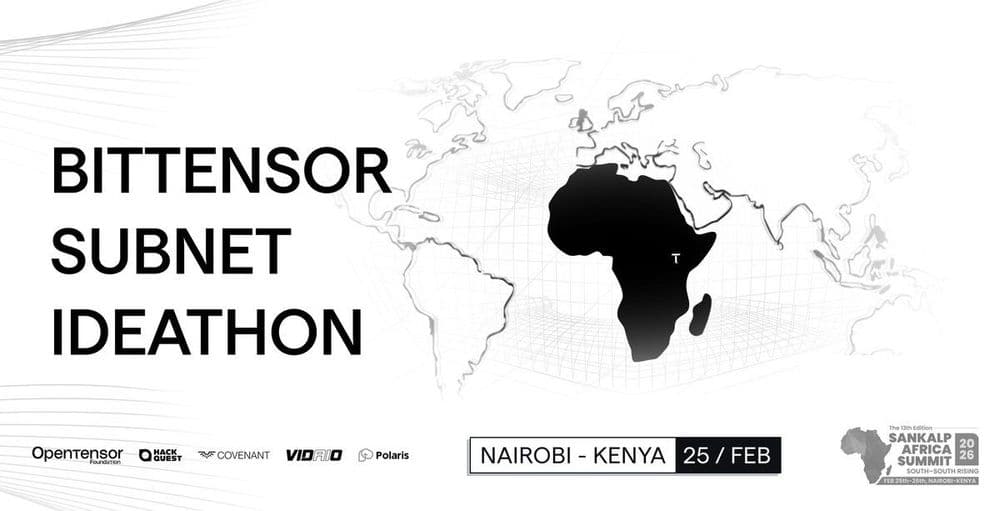
The Bittensor Ideathon landed in Nairobi, Kenya, as part of the Sankalp Africa Summit 2026. HackQuest organized the event in collaboration with Opentensor. African builders and developers pitched real-world subnet ideas on the Bittensor network. Two projects stood out, and both addressed problems that extend well beyond crypto.
What Was the Bittensor Ideathon at Sankalp Africa Summit?
The Bittensor Ideathon is a global competition where developers design and pitch new subnets. Unlike a traditional hackathon focused on code, it emphasizes problem-driven thinking and incentive design. Participants present subnet concepts with clear miner-validator roles that could realistically operate within Bittensor.
The Sankalp Africa Summit is one of Africa’s largest gatherings for impact investing and social entrepreneurship. The 2026 edition took place on February 25 and 26 at the Sarit Expo Centre in Nairobi. Its theme was “South-South Rising.” Over 50 countries were represented by entrepreneurs, investors, and thought leaders focused on Global South collaboration. The venue placed decentralized AI in front of development finance institutions, NGOs, and social enterprise founders.
Mentors Sam (@DistStateAndMe) and Gareth Howe (@GarethHowe95938) supported the event. Andres Marquez Lara (@amarquezlara) from Ufacilitate handled hosting. Ufacilitate is a facilitation and systems-design firm running Bittensor hackathons across Mexico, Nigeria, Kenya, and Japan.
Who Won the Bittensor Ideathon in Nairobi?
Two projects took top honors. Wade Walton (@wadewalton13) won first place with a Medical AI for Pre-screening subnet concept. David Opiyo (@OpiyoisCreative) earned the runner-up spot with a Creative Subnet proposal. HackQuest called the pitches sharp and problem-driven.
The Nairobi event is part of the Build on Bittensor campaign. HackQuest and Opentensor launched it in early 2026 to run workshops, ideathons, and learning programs worldwide. Earlier stops included Kolkata, Machakos, and several cities in China. The campaign has attracted over 500 developers, university students, and AI researchers so far.
What Is the Medical AI Pre-Screening Subnet?
Wade Walton’s concept proposes a Bittensor subnet that uses AI to pre-screen medical images. It targets a well-documented healthcare gap. According to the Radiological Society of Southern Africa, South Africa has roughly one radiologist per 100,000 people. Europe averages about 13 per 100,000. Research in the Chinese Journal of Academic Radiology found that Ghana has about three radiologists per million people. Seven of Ghana’s 16 regions have none at all. Some estimates suggest that 14 African countries have no practicing radiologists whatsoever.
The subnet would run AI models that analyze medical images and flag potential abnormalities. Miners would compete to provide accurate analysis. Validators would evaluate output quality. This could make AI-powered pre-screening available without relying on a single centralized provider.
According to HackQuest, the framework can extend across multiple clinical workflows. It is not limited to one type of scan or diagnosis. If implemented, it could serve public health systems that lack specialist capacity for their imaging volume.
What Is the Creative Subnet?
David Opiyo’s proposal envisions a subnet where artists and designers contribute styles, datasets, and creative intelligence to AI training. In return, they earn rewards through the Bittensor network.
The concept addresses a recurring tension in the AI industry. Large AI models train on vast amounts of creative work. The original creators rarely benefit. Opiyo’s subnet would create a permissionless marketplace for creative contributions. Miners would submit assets and data. Validators would assess quality and originality. Token rewards would flow to contributors whose work proves most valuable.
According to HackQuest, the subnet represents a model for connecting Africa’s creative economy with open AI infrastructure. The concept aligns with broader conversations about fair compensation for training data in the age of generative AI.
Why Does This Matter for the Bittensor Ecosystem?
The Nairobi event shows how the Bittensor developer community is expanding. A Subnet Ideathon at an impact investing summit reaches a new kind of audience. That includes development professionals, social entrepreneurs, and institutional investors new to decentralized AI.
Both winning ideas illustrate the range of problems that subnets can address. A medical pre-screening subnet and a creative compensation subnet differ in scope. But both rely on the same core mechanism: miners produce useful output, validators evaluate quality, and token incentives keep the system running. Applied to a concrete problem, a subnet functions as a practical service.
What Comes Next for the Bittensor Ideathon?
The global Subnet Ideathon has multiple rounds. Round one focuses on subnet design and pitch decks. Round two invites selected teams to build on the Bittensor testnet. Final winners are expected at the end of March 2026.
Prizes include pitch sessions with Bittensor co-founder Jacob Robert Steeves or Opentensor Foundation president Etienne. Ecosystem funds like Unsupervised Capital may offer investment support to standout projects.
HackQuest and Opentensor plan to continue Build on Bittensor throughout 2026. More workshops and ideathon events are planned across new cities and regions. A dedicated Bittensor Learning Path is also in development. It will cover subnet architecture, mining mechanics, and onboarding for new developers.
For the Nairobi winners, the next step depends on advancing through the global competition. Both projects are currently at the ideation stage. Neither has been implemented as a live subnet on the Bittensor network yet.