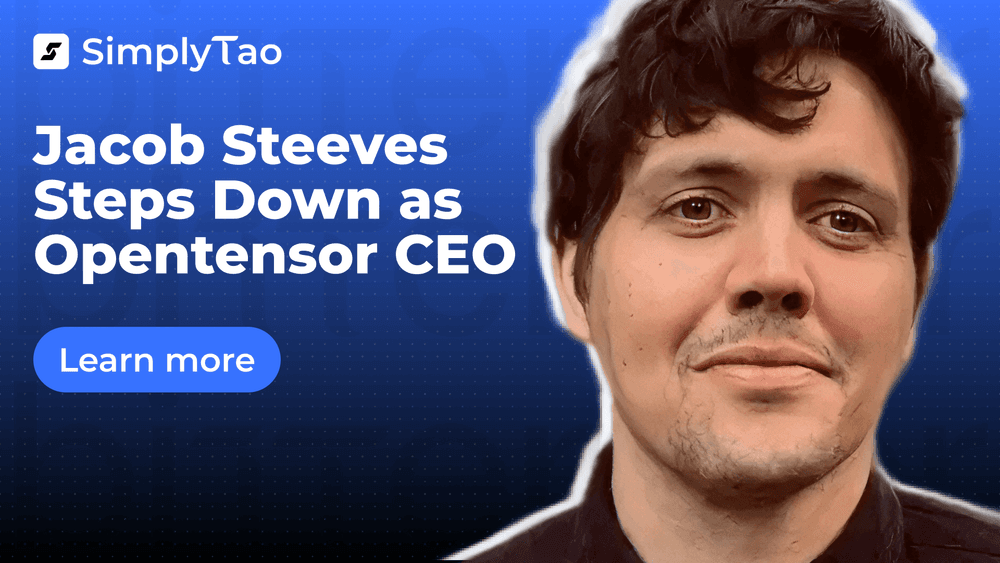
Jacob Steeves Steps Down as Opentensor CEO
Jacob Steeves, widely known across the ecosystem as Const, announced that he is stepping down as CEO of the Opentensor Foundation, the entity that has historically played a central role in the Bittensor network. At the same time, co-founder and COO Ala Shaabana, known as ShibShib, confirmed he is also stepping aside from his executive role.
Importantly, neither founder is leaving the ecosystem. Instead, this appears to be a deliberate move aimed at accelerating Bittensor’s long-promised transition toward full decentralization.
“Not Much Will Change” as Const Clarifies His Role
Shortly after the announcement, Const addressed the community directly and made it clear he remains fully active in development and ecosystem building.
He wrote:
Not much will change, I’m still going to be in the same calls and do the same things and continue to write chain code, and make subnets, and run novelty search and call people scammers and suggest changes — just not with the same legal authority (and that’s important )
That final line may be the most important part of the announcement. Const is not stepping away from Bittensor’s technical direction. He is stepping away from the formal legal authority attached to leadership titles.
In other words, this is decentralization being executed in practice, not just promised in theory.
The Community Reaction Signals Respect and Confidence
The announcement quickly spread across X, drawing widespread support across the Bittensor community.
A notable response came from @DreadBong0, who highlighted how long Const has carried the decentralized intelligence vision through years of doubt, criticism, and volatility. He framed the decision as a rare moment where founders voluntarily reduce their own power to strengthen the credibility of the network itself.
The broader sentiment was clear. This was not seen as a leadership vacuum, but as a deliberate governance evolution.
Why the Opentensor Leadership Shift Matters
Bittensor has long positioned itself as the decentralized alternative to Big Tech’s AI monopoly, a protocol designed to reward open intelligence creation through market-driven incentives.
Const first conceived the idea around 2015 while researching machine learning. After joining Google as a machine learning engineer, he continued building the early foundations of the protocol on the side. In 2018, he committed to Bittensor full-time, eventually launching mainnet in January 2021 through the OpentensorFoundation.
However, despite the project’s decentralization narrative, critics have frequently pointed to the influence of the foundation itself, especially in areas like validation structure, governance perception, and concentrated stake weight among top validators.
By stepping down, Const and ShibShib directly address the single biggest criticism Bittensor has faced, the perception that the ecosystem still depends too heavily on a central organization.
A Move That Matches the Network’s Decentralization Trajectory
The leadership transition comes after a year of major protocol upgrades that already pushed Bittensor further away from centralized control.
In February 2025, the network introduced Dynamic TAO (dTAO), a major emissions and incentive redesign. The upgrade enabled subnet tokens and introduced market-based allocation mechanisms, meaning rewards could increasingly flow based on decentralized subnet performance rather than top-down distribution.
Later, on December 15, 2025, Bittensor completed its first-ever halving event, reducing TAO issuance and drawing comparisons to Bitcoin’s early halving cycles. That milestone also increased institutional interest, with firms such as Grayscale and Bitwise filing with the SEC to offer TAO-linked investment products.
Looking ahead, the 2026 roadmap continues the same direction, including expanding subnet capacity from 128 to 256 and strengthening security and economic design through mechanisms like MEV Shield and Tao Flow.
Seen in that context, the founders stepping down from formal leadership roles feels less like a surprise and more like the next logical step.
What This Means for TAO Holders
For TAO holders, this announcement is likely a net positive.
In crypto markets, long-term credibility is often determined not by what teams claim, but by whether they are willing to decentralize even when it reduces their control. Founders voluntarily givinguplegalauthority while remaining active builders is one of the strongest signals that a network is structurally resilient.
This is particularly important given the timing. The subnet economy is expanding rapidly, institutional exposure to TAO is increasing, and regulatory attention is rising. A more decentralized governance structure reduces key-person risk and strengthens Bittensor’s legitimacy as a truly permissionless AI network.