Your Simple Guide to Swarm (SN124)
Drones already deliver parcels, inspect bridges and power lines, and search for people after avalanches and earthquakes, and the money follows the trend: Grand View Research valued the commercial drone market at 24.4 billion dollars in 2025 and projects 52.1 billion by 2033, while Fortune Business Insights sizes the narrower autonomous drone systems segment at 12.46 billion dollars in 2025, rising to 42.06 billion by 2034 at a compound annual growth rate of 14.6 percent. The airframes and the sensors are mostly a solved problem. The flying is not. Almost every serious autonomy stack is trained behind a closed door and measured on a private test set, so nobody outside the company can check whether a claimed success rate means anything, and nobody can tell whether one lab's controller is better than another's. That leaves the hardest part of the industry, the software that decides where a drone goes next, without a shared, verifiable benchmark. Swarm (SN124) addresses this challenge by turning drone autonomy into an open, weekly competition on Bittensor, where anyone can submit a trained flight controller and have it scored on thousands of simulated worlds it has never seen before. Submissions are ranked on a public leaderboard, rewards are paid by the network according to how much a model advanced the best known result, and the winning pilots have already been flown on real hardware.
What is Swarm (SN124)?
Swarm is the Bittensor subnet that runs an open benchmark and reward system for autonomous drone navigation, operating as Subnet 124 on the Bittensor mainnet and licensed under MIT. The team describes the project as building the autopilot operating system for drones, and describes the subnet itself as the open arena that settles which flight controller is actually best. The name is literal rather than metaphorical: several of the competitions require a coordinated group of drones rather than a single aircraft.
The nearest comparison is not a research lab but a standards body with a scoreboard. Instead of publishing results each team measured for itself, Swarm (SN124) fixes the environment, the sensors, the time limit, and the scoring formula, then lets anyone bring a model and be measured against the same conditions as everyone else. Because the worlds are generated fresh each week, a model cannot memorise the test.
Two participant classes do the work. Miners train a flight controller and commit a public GitHub repository address on chain, after which they can go offline, since the miner process only submits the pointer. Validators download the submitted model, run it inside a sandboxed Docker container on their own hardware, score it across the week's world set, and set on-chain weights based on stake-weighted consensus, so no single validator can advance or block a model alone.
What the subnet produces is a public record of the best known drone pilots plus the models themselves, which are published in miner repositories, and a live leaderboard and per-epoch seed list on the project's website. The team has also built Langostino, an open-source, 3D-printed reference drone running ROS2, specifically to fly the trained models on physical hardware. According to a TAO Media report, a Swarm model called SOTAPilot reached a 95.34 percent success rate across the six procedural world types before flying on the Langostino airframe. That figure comes from the project's own benchmark rather than from an independent test.
The structural difference from a centralised autonomy team is that no participant controls the evaluation. Validators generate their own seeds independently, the same benchmark engine that scores a model on chain is the one a miner can run locally, and every submission is a public repository, so a result that cannot be reproduced does not stand.
How Swarm works?
Every mission runs the same control loop. The drone sees the world through a single simulated depth camera producing a 128 by 128 depth map covering a range of roughly half a metre to twenty metres, plus a state vector holding position, velocity, orientation, altitude, recent action history, and a rough direction toward the search area. Fifty times a second, the submitted model reads that input and returns five numbers: three direction components, a thrust multiplier, and a target yaw angle. Top speed is capped at 3.0 metres per second and each episode ends after 60 seconds. There is no map, no GPS fix on the target, and no list of obstacle coordinates. The goal direction carries deliberate noise, up to twenty metres horizontally and three metres vertically, so the model has to sweep the area with its depth sensor and find the actual target.
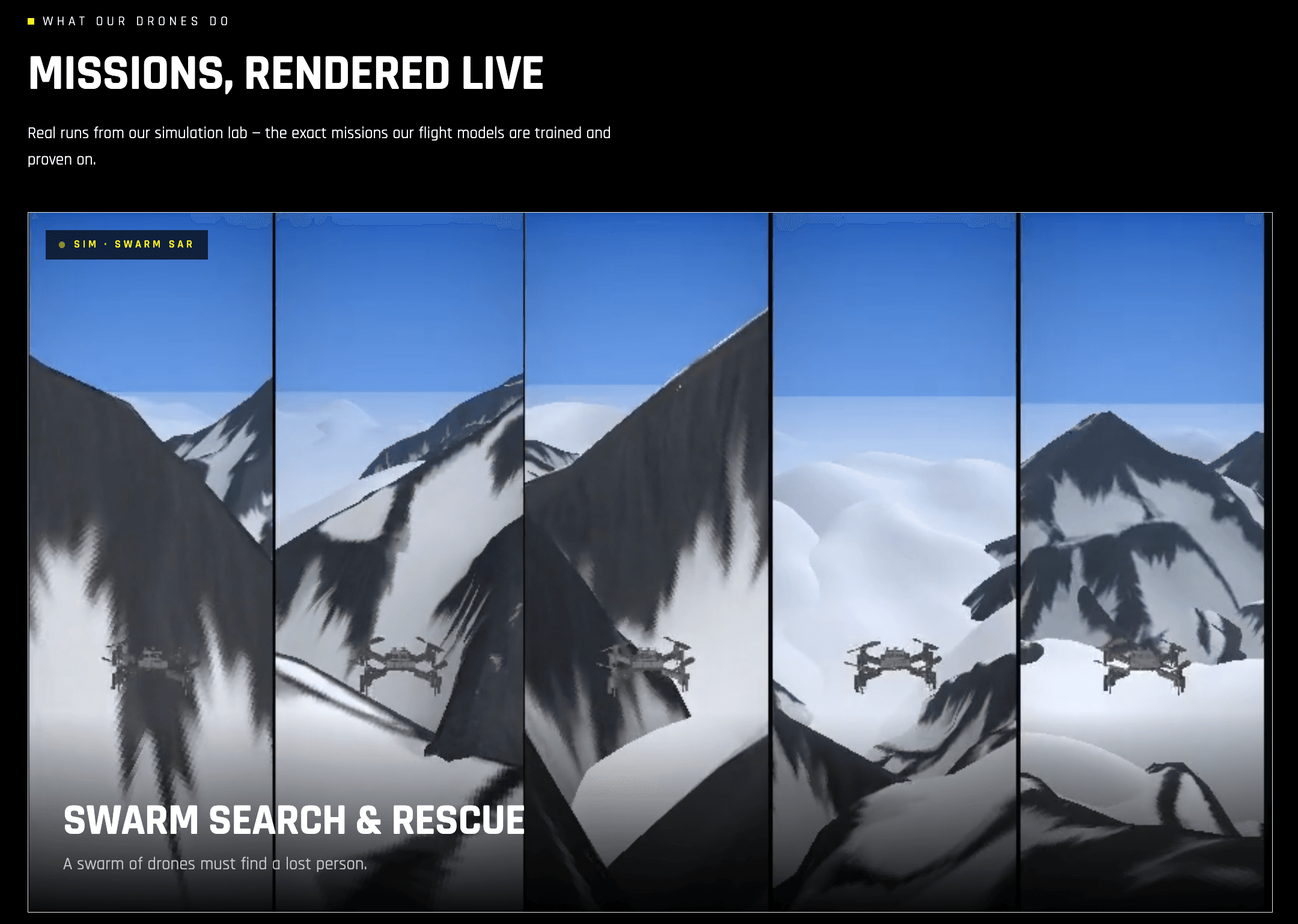
The view above is the third-person camera from a benchmark run; the model itself only ever sees the depth image. Worlds come from six generators, City, Open terrain, Mountain, Village, Warehouse, and Forest, with the forest generated in four seasonal variants. Each validator independently generates 1,100 cryptographically random seeds per epoch using the system random source, with no shared secret between validators, and the seed set rotates every seven days at 16:00 UTC on Monday. Per-epoch seeds are published on the project's website afterwards for transparency.
Scoring is a weighted sum. For the landing and rescue missions, a flight earns 0.45 for success, meaning a valid landing or a held hover over the target, 0.45 for time, which is full marks inside a per-seed target and decays linearly to zero at the 60-second horizon, and 0.10 for safety, based on minimum clearance from obstacles. Colliding with anything drops the score to 0.01. The time target is computed from each seed's own distance and search radius, so a wide search area does not make a perfect score unreachable, it just demands an efficient sweep. Interceptor, the air-to-air pursuit mission, drops the safety term and splits its score evenly between success and speed. A model's rank is its average across the whole seed set, which means consistency beats a few lucky runs.
Swarm runs five separate competitions, called challenge families, each with its own champion lineage and its own slice of subnet emissions. Search and Rescue asks a single drone to find a lost person and hold a steady hover above them, Swarm Search and Rescue gives the same task to a team sweeping the area together, Swarm Autopilot requires a whole team to land quickly without collisions, Interceptor requires chasing down and catching a fleeing drone, and Autopilot requires crossing the world, finding a landing pad, and touching down cleanly. The allocations are set by the team rather than derived automatically, and the King of the Hill document currently lists Interceptor at 0.30 of the pool, Swarm Autopilot and Swarm SAR at 0.20 each, and Autopilot and Search and Rescue at 0.15 each. The repository README lists a different split, so readers checking the exact percentages should treat the King of the Hill document as the mechanism reference and expect the numbers to be restated when governance changes them.
Rewards use a King of the Hill design rather than winner-take-all. Each family keeps a window of its last five champions, and all five earn. A seat's weight is 0.7 raised to its rank, so the reigning champion holds full weight and each older seat keeps 70 percent of the one above it, down to about 24 percent at the bottom. On top of that, each king carries a log-headroom gain locked at the moment of crowning, calculated from how much of the remaining distance to a perfect score of 1.0 it closed, which grants a bonus of up to 30 percent. That combination is the anti-copying measure: a miner who clones the champion and adds noise to scrape past the threshold locks in a tiny gain and earns a tiny share, while the miner who moved the frontier keeps earning through four more dethronings.
Several other rules exist to keep the mechanism honest. Taking the throne requires clearing the current champion by a dynamic crowning floor, which is flat while the champion sits at or below 0.5 and then shrinks as the score approaches 1.0, running from 0.015 down to 0.005 for most families and 0.02 down to 0.007 for the two search-and-rescue families. Each hotkey may commit one model for its lifetime, so a miner cannot iterate on a registered slot and must register a new hotkey to try again. Submissions are capped at 50 MiB compressed, dependency lists are restricted to an approved package whitelist, and the repository README must match the template byte for byte by SHA-256 hash, with duplicate model hashes and duplicate repository addresses rejected outright. If a family goes seven days without a new crowning, its whole slice burns until someone raises the bar again, and a champion who wants to keep the slice alive has to beat their own score from a fresh hotkey. One inconsistency is worth knowing about: the miner guide still describes a ten-champion window and a 300-seed screening phase, while the King of the Hill document describes the five-king window and says the screening pre-phase is disabled behind a build-time constant.
Taken together, the design rewards one thing above all others: a measurable, reproducible improvement on the best known result, made in public.
Who is behind Swarm (SN124)?
Swarm publishes limited information about individual contributors. The GitHub organisation has no public members, and the repository documentation points miners to two maintainers by their community handles, Miguelikk and AliSaaf, who handle support in the project's Discord. Independent subnet directories that have covered SN124 describe the team as a small group of AI engineers and drone builders and note the same absence of published biographies, so any claim about specific founders should be treated as unverified until the team publishes it.
What is documented is the output. The main repository holds more than a thousand commits, is 99.3 percent Python, and separates benchmark orchestration, validator scoring, world generation, and Docker-isolated model execution into distinct packages, with a published architecture document setting rules for where new code belongs. The organisation also maintains the Langostino hardware repository and a fork of the PyBullet drone gym environment the simulator builds on.
On the corporate side, the team announced in April 2026 that SWARM124 had been selected for Enlaira, described in the announcement as Andorra's official startup acceleration programme, as one of five companies chosen nationwide. That is the project's own statement of the selection rather than an independently reported one. No funding round, legal entity, or investor list has been published.
The project's public channels are its website, its X account, its Discord server, and the swarm-subnet GitHub organisation, all of which are listed in the source block below. Swarm is not operated by Dendrite and has no relationship to SimplyTao beyond editorial coverage.
Why Swarm (SN124) is valuable?
The weakness Swarm targets is not a shortage of drone autonomy research, it is the absence of a shared measuring stick. When every lab reports on its own test set, a stated success rate carries no information about how the same controller would behave in an unfamiliar warehouse or a dead winter forest. Fixing the sensor suite, the time limit, the scoring weights, and the world generator, then rotating the worlds weekly, converts a marketing number into a comparable one.
Open competition suits this problem specifically because drone navigation has an enormous space of viable approaches. End-to-end reinforcement learning, classical planning with a learned perception front end, and hybrid controllers are all defensible, and a single team can only staff two or three of them. A permissionless benchmark lets dozens of independent attempts run in parallel, and the King of the Hill payout structure means the network pays for the ones that actually move the record rather than for the one that happens to be sitting on top this week.
The direct beneficiaries are builders who need a starting point. Because every submission lives in a public repository under a permissive licence, a robotics team can pick up the current champion's approach rather than starting from zero, and a hardware project can put a leaderboard-tested controller onto an airframe. Miners benefit from an unusually low barrier to entry, since the miner process does nothing but publish a pointer and any machine with Python 3.11 can run it, with the real cost sitting in training rather than in uptime.
The commercial argument rests on the gap between simulation scores and deployable software. If the reported 95.34 percent benchmark success rate for SOTAPilot transfers to physical airframes as the Langostino flights suggest, the output is a depth-camera autopilot that works without GPS or a prior map, which is precisely the capability that indoor inspection, warehouse work, and mountain rescue need and that satellite-dependent stacks cannot provide. Against a segment forecast to reach 42.06 billion dollars by 2034 on Fortune Business Insights numbers, an openly licensed controller with a verifiable score is a plausible input for operators who cannot afford to build autonomy in house.
There is ecosystem value too. Swarm is one of the few Bittensor subnets producing robotics artefacts rather than text or images, and its benchmark harness, world generators, and Docker evaluation runtime are reusable by any subnet that needs to score submitted models in a sandbox on rotating tasks.
The future of Swarm (SN124)
The most consequential development so far is the move from simulation to hardware. Langostino is a complete, documented, 3D-printed drone platform, and the team has published video of an autonomous flight using a model trained on the subnet. That closes the loop the whole design depends on, because a benchmark score only matters if it predicts behaviour in the air.
On the product side, the expansion from a single landing task to five challenge families, including two team-based search-and-rescue competitions and an air-to-air Interceptor, is the clearest signal of direction. The team has said the emission split across families is re-decided and announced when it changes, which means further families are expected rather than ruled out, though none has been announced. The Enlaira selection points toward commercial packaging of the subnet's output; what that produces in practice has not been detailed publicly.
The stated ambition is larger than a leaderboard. The team's public framing is an autopilot operating system for drones, with a target of deploying its models across ten thousand aircraft, a goal it has stated as an aspiration rather than a roadmap item with a date.
Whether that arrives or not, the mechanism is the part worth watching. Most Bittensor subnets reward a model for being best right now, which pays the incumbent and quietly encourages cloning. Swarm (SN124) pays for the size of the jump and keeps paying for four more dethronings, burns a family's emissions when a week passes without progress, and gives each hotkey exactly one submission. That is a bet that a benchmark can be made expensive to game and cheap to enter at the same time. Robotics is an unforgiving test of the idea, since a simulated score that does not survive contact with real air is worth nothing, and the honest open question is how far the physical validation extends beyond the team's own airframe.
Source:
https://swarm124.com/ https://github.com/swarm-subnet/swarm https://github.com/swarm-subnet https://x.com/SwarmSubnet
Frequently asked questions
What is Swarm (SN124)?
Swarm is Bittensor Subnet 124, an open benchmark and reward network for autonomous drone navigation. Miners train flight controllers and submit them; validators score each one across 1,100 procedurally generated simulated worlds per week and set on-chain weights accordingly. Five separate mission families run in parallel, each with its own champion lineage and share of emissions.
How do I mine on Swarm (SN124)?
You train a controller that implements the required agent class, package it under the 50 MiB compressed limit, benchmark it locally with the same engine validators use, then commit your public GitHub repository address on chain from a registered hotkey. The miner process exits after submitting, so you do not need to stay online. Each hotkey gets one submission for its lifetime, so the practical advice in the project's own guide is to only commit once the model consistently beats the champion locally.
Is Swarm open source?
Yes. The subnet code is distributed under the MIT licence, the Langostino hardware platform is published with a build guide, and every miner submission lives in a public GitHub repository that validators download directly. Per-epoch seeds are published on the project's website after each rotation.
What makes Swarm different from a private drone autonomy company?
Nobody involved controls the evaluation. Validators generate their own seeds independently with no shared secret, the same benchmark engine runs locally and on validator hardware, and results are reproducible because both the worlds and the models are public. A private lab can claim any success rate it likes; a Swarm score can be checked.