404-GEN (SN17) Announces Atlas: Enterprise 3D Generation
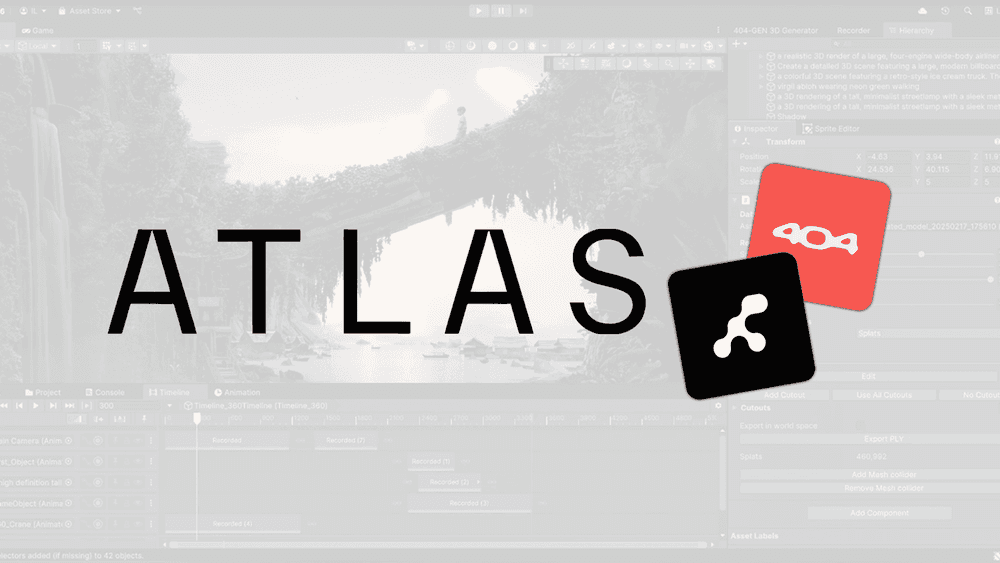
404-GEN (SN17) Atlas is the latest move from one of Bittensor's most enterprise-focused subnets. The team behind Subnet 17 has formally introduced Atlas as its dedicated application layer for professional game studios. Atlas transforms raw 3D generation from the decentralized network into production-ready assets, complete with texture refinement, format conversion, and multi-model orchestration. The announcement outlines a two-layer architecture that positions 404-GEN as open infrastructure and Atlas as the commercial interface built on top of it.
A Team of 15 Engineers Building on Bittensor
404-GEN is led by founder and CEO Ben James, who discovered Bittensor in early 2024 and saw an opportunity to build a subnet dedicated to 3D AI generation. The team has since grown to 15 AI engineers and researchers with deep roots in gaming, VFX, and virtual world development. Rather than building a traditional company around their technology, they chose to launch a Bittensor subnet where open competition drives continuous improvement.
The reasoning is straightforward. On a centralized platform, model quality improves when the company invests in research and development. On Subnet 17, quality improves because miners compete daily to produce the best 3D outputs. Speed improves because generation time directly affects rewards. And costs decrease over time as decentralized compute scales and miners optimize for efficiency.
The Vision: Large Spatial Models
The long-term goal behind 404-GEN (SN17) Atlas is to build toward what the team calls Large Spatial Models. This refers to AI that understands how objects exist and relate in three-dimensional space. Current language models handle text exceptionally well, but they struggle with spatial reasoning. The ability to understand and generate 3D content is, in the team's view, the missing capability between text-based AI and systems that can physically interact with the real world.
To build toward that vision, Subnet 17 runs structured 3D AI competitions. Miners submit open-source code that generates a range of 3D assets, including meshes and Gaussian splats, with procedural representations planned as a future addition. Validators evaluate those outputs for quality, speed, and structural integrity. Because submissions are open-source, miners build on top of each other's work. This creates a compounding effect where each competition cycle pushes the overall technology forward.
The competition format itself has evolved significantly. Early cycles focused on industry-standard benchmarks like generation speed and prompt similarity. As miners consistently surpassed those thresholds, the team introduced a leader-challenge model. Challengers generate 3D assets from the same prompts as the current leader, and a Visual Language Model judges each matchup. To dethrone the leader, a challenger must win by a clear margin and pass an audit. Every round is logged to a public dashboard, creating both transparency and a strong incentive to improve.
From Innovation to Adoption
404-GEN has taken a deliberate approach to proving that technical innovation can translate into real-world usage. The team draws a direct parallel to Midjourney, the 2D AI image generation company. Midjourney started by offering a free product that drove widespread adoption among individual creators. That adoption generated insights and feedback loops, which built network effects, and ultimately led to significant revenue within the first year of introducing paid subscriptions.
404-GEN follows a similar path. The subnet's technology is accessible through multiple integration points designed to meet developers wherever they already work. These include a Unity plugin (the first decentralized 3D model generation tool to become an official Unity Verified Solution), a Blender add-on (their most popular open-source integration), a web application, a Discord bot, and a direct API for custom integrations.
This multi-platform availability is producing real results. The team reports hundreds of downloads each month from the Unity Asset Store alone. At the Super AI conference in Singapore, Ben James met a developer who had built an entire VR game using 404-GEN assets after discovering the tool through Unity, without even knowing about Bittensor. Use cases have extended beyond gaming into architecture, 3D printing, and XR applications.
What Atlas Actually Does
404-GEN provides the open infrastructure layer, while Atlas is one commercial product built on top of it - and by design, not the only one. The announcement frames this as a two-layer stack: the intelligence layer (Subnet 17, where models compete and improve) and the application layer, where those capabilities are assembled into enterprise-ready workflows and products. Atlas is 404-GEN's commercial product targeting enterprise, built on open infrastructure designed to support an entire ecosystem of products.
Enterprise game studios need more than raw 3D generation. They need full production pipelines. A Gaussian splat might be visually impressive but require mesh level-of-detail conversion for gameplay. A fast-generation mesh might need 2D texture refinement before it meets studio standards. Atlas handles this by combining 404-GEN outputs with other AI models in node-based workflows that cover texture refinement, format conversion, quality filtering, and multi-model orchestration.
The pricing model is usage-based. Customers pay per generation, per asset, and per API call. When users generate assets through Atlas, the platform makes clear that generation is powered by 404-GEN. Paying customers on Atlas that use 404-GEN pay 404-GEN directly. Atlas takes no cut of that revenue.
Enterprise Validation: Square Enix and Google Cloud
The Atlas layer is already producing enterprise traction. Joseph Burnette, Technical Director at the Innovation Technology Division of Square Enix (one of the largest game publishers in the world), has acknowledged the platform's ability to integrate with highly customized production workflows.
In August 2025, Atlas announced a strategic partnership with Google Cloud. The platform is built entirely on Google Cloud's scalable infrastructure and leverages Vertex AI for model orchestration. Atlas is also available through the Google Cloud Marketplace, giving studios worldwide direct access. The partnership included the launch of a closed beta program for qualified studios and developers.
Jack Buser, Global Director for Games at Google Cloud, publicly endorsed Atlas as a platform enabling a new wave of AI-native game development through agentic design systems. The company claims its technology can accelerate development workflows by up to 200 times compared to existing tools. Atlas integrates directly with professional environments like Unreal Engine, Unity, and Houdini.
Global Visibility at Major Industry Events
Over the past year, 404-GEN technology has been showcased at several of the world's most prominent industry events. These include GDC (the Game Developers Conference, the gaming industry's largest professional gathering), Gamescom (Europe's largest gaming event), the World Expo in Osaka, and the Venice Architecture Biennale. This event presence signals that the technology is gaining recognition well beyond the Bittensor ecosystem and into mainstream creative industries.
What Comes Next
The 404-GEN (SN17) Atlas announcement represents a clear strategic direction. Subnet 17 will continue evolving its competition system toward Large Spatial Models, progressively innovating and making key 3D AI technologies more accessible. The open infrastructure will support a growing ecosystem of builders creating games, world models, AR/VR/XR experiences, digital twins, and other immersive applications.
Atlas will focus on enterprise adoption and scaling revenue through professional studio relationships. With millions of generated assets already produced, a proven competition system with active miners improving models daily, and enterprise partnerships with Square Enix and Google Cloud already in place, the foundation is established.
The team's stated ambition is to build the spatial-reasoning foundation for the next wave of AI innovation, one that operates at the scale of major centralized AI providers while maintaining the openness and incentive alignment that decentralization provides.
Sources:https://doc.404.xyz/atlas-and-404https://www.404.xyzhttps://github.com/404-Repohttps://atlas.design