NOVA Nanobodies Enter Experimental Validation With Yalotein
NOVA nanobodies are leaving the computer and heading for the laboratory. Metanova Labs has teamed up with Yalotein, a biotechnology company, to build the designs as real proteins. Until now those designs existed only as predictions on a screen. They come from a contest on Bittensor Subnet 68. So a laboratory will finally check whether they work.
Nanobodies are tiny antibodies. Antibodies work as guards of the immune system, and they stick to invaders so the body can clear them. Camels and llamas make a stripped down version, and each one weighs about a tenth of a human antibody. Because they are so small, they reach spots on a protein that big antibodies cannot touch. They also cope well with heat and cost less to make. Caplacizumab, the first approved nanobody drug, reached patients in 2018 and 2019.
How NOVA Nanobodies Went From Predictions to Proteins
The target is the part of the body a drug has to grab. All of this scoring runs on computers, so the industry calls it virtual screening. Yalotein now handles the physical side. First, it grows the winning designs as real proteins. Then a laboratory measures how well they stick. An earlier roadmap pointed to a first batch of about fifty candidates. So NOVA nanobodies now face the only test that really counts.
These tests answer one question. Did the software get it right? Because a prediction can look excellent and still fail on the bench, this batch turns contest results into evidence. Real proteins also let the team report a hit rate. A hit rate is the share of computer picks that work in the laboratory. That number can then be set against classic drug hunting methods.
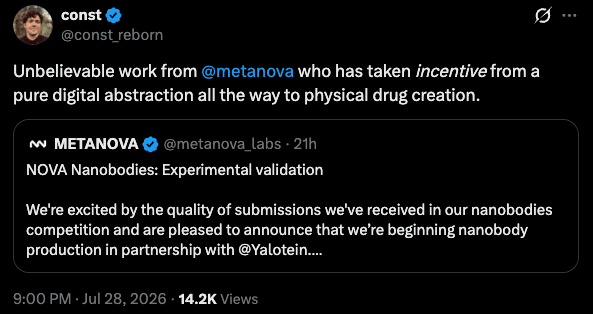
Metanova framed the news as part of a bigger plan. The team wants a discovery engine that can carry many drug types under one reward system. Its small molecules program shows the scale already reached. Reports from May 2026 put NOVA past eleven million molecules screened across nine live disease targets. Jacob Steeves, known as Const, praised the step on X. The Bittensor creator called the work unbelievable. In his words, Metanova has carried reward design from "a pure digital abstraction" into real drug creation.
Some caution helps here. Early discovery is the cheap part of drug work, and most leads still fail later in human trials. Even so, NOVA nanobodies in a laboratory turn network activity into proof a scientist can check.