Meta Made the Case for Decentralized AI, Then Kept the Keys
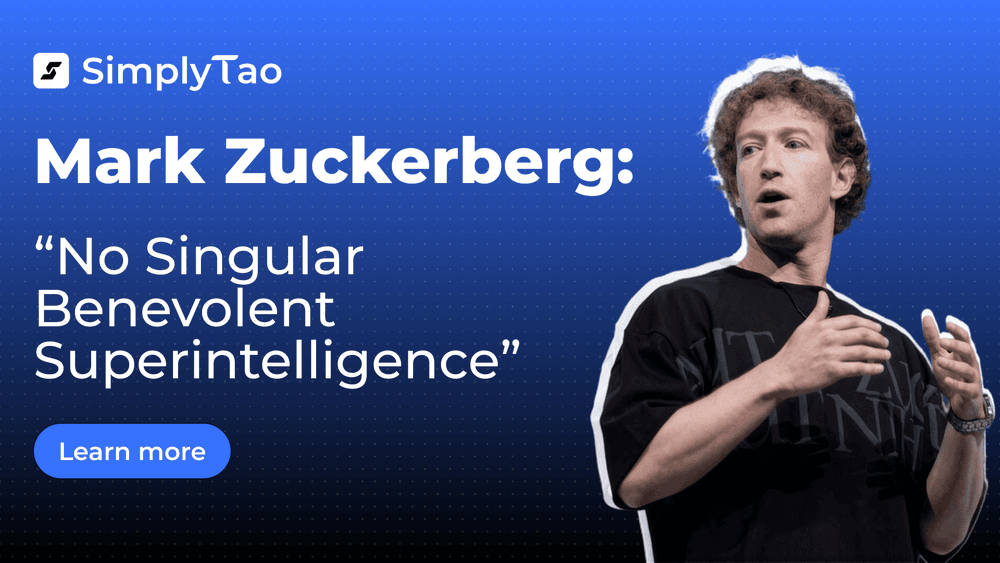
Mark Zuckerberg spent roughly 6,500 words on August 10 arguing that concentrated AI is the real risk. "There is no such thing as a singular benevolent superintelligence" - he wrote. Bittensor has been making that argument in protocol form for years. The difference is where Meta stops. It still trains the frontier models, controls the capacity and runs the auction pricing access. Intelligence becomes widely available. Control rights and cash flows stay concentrated, and that gap is the case for decentralized AI.
What Zuckerberg conceded
The letter argues that alignment cannot produce one benevolent system, since people hold genuinely opposing values. Safety therefore comes from balance of power, with many agents checking each other. Zuckerberg adds that the most dangerous outcome available is a leading lab building powerful models and keeping them to itself.
He goes further than most coverage noticed. The letter concedes that any lab refusing to point compute at recursive self improvement will fall behind. That describes a race nobody exits alone. His proposed check is several frontier labs holding different values. Read another way, that is an argument for control sitting outside the labs. An independent board can constrain management. It does not distribute model release, capacity or pricing.
Where Meta's plan stops being decentralized AI
Meta commits to free tiers, selected open weight releases and board approval of safety criteria. It also proposes a dynamic auction mechanism setting what compute costs. Users can consume that intelligence and bid for more of it. They don't control the capacity, the auction rules, or the economics sitting behind either.
Ownership here means something specific. Not a deed to a GPU, but open participation in supplying the work, allocating capital and capturing what the protocol pays out. Meta remains platform operator, capacity gatekeeper and counterparty. Its own guidance puts 2026 capital expenditure, including finance lease principal payments, at 130 to 145 billion dollars. Meta's auction rations compute. Bittensor's market rations emissions. The question is who controls each side.
The strongest case for Meta's version
Scale is the honest defence, and it deserves stating plainly. Billions of people may receive cheap access almost immediately. Selected open weights move some deployment off Meta infrastructure entirely, which nobody in this ecosystem can match on reach. That is real distribution. It remains distribution by a platform rather than distribution of the platform.
For most users that distinction will stay invisible. It matters for anyone building a business on top, because the terms remain revisable by one counterparty.
What decentralized AI actually costs on Bittensor
Bittensor runs a live and imperfect version of the separation Zuckerberg describes. Subnet owners define the incentive mechanism, while miners supply the work and validators score it. Capital markets price demand across subnets. Emissions split 18 percent to the subnet owner, 41 percent to miners and 41 percent to validators and their stakers.
Participation is open by default, though not governance free. Root governance can close registration on any subnet. A new subnet receives no TAO emission share until root switches it on. Bittensor's own documentation describes chain admin keys still held by a multisig inside the Rao Foundation, pending renunciation. Jacob Steeves, known as Const, calls this the most decentralized AI protocol in existence, and the honest version of that claim is narrower. Bittensor has not removed every key. It has made more keyholders visible, contestable and economically exposed.
Quality is the second cost. An independent analysis this month found that most of one released subnet model was identical to an existing model, and the token fell roughly 75 percent within hours. Decentralization removes a single owner. It does not remove failure. It redistributes the work of detecting and pricing it.
The honest summary is that Meta delivered the best marketing Bittensor received all year, then attached a different ownership model to it. Personal superintelligence for everyone is already Meta vocabulary, with last year's letter and this year's budget behind it. Bittensor will not win by repeating those words more quietly. It can win by making the institutional difference legible: who may supply the work, who defines the evaluation, who controls allocation, and who gets paid.