Is Quasar (SN24) a Scam? What's Actually Going On
Quasar is Subnet 24 on Bittensor, run by a team called SILX AI. Its pitch was ambitious: build an AI model that can read millions of words at once, and train it using Bittensor's decentralized network of miners instead of an expensive data center.
At the end of July 2026, an independent researcher downloaded the model Quasar had published and compared it, piece by piece, to an existing free model made by another company. The finding: the overwhelming majority of the file was an exact, unmodified copy.
The market reacted before anyone could argue about it. The token dropped roughly 75% in a matter of hours. Discord melted down.
The team has now published a long response. It admits a serious mistake, denies the fraud, and provides evidence. Some of that evidence holds up. Some of it doesn't. And a chunk of the original problem still hasn't been addressed at all.
Here's the whole thing, in order, without the jargon.
What Quasar was supposed to be
Some background, quickly.
Quasar's promise had two parts. First, a technical one: most AI models have a limited "memory" for how much text they can consider at once. Quasar claimed it was building models that could handle up to 5 million tokens - roughly the length of a small library - using a new attention mechanism it had designed.
Second, an economic one: instead of renting thousands of GPUs from a cloud provider, Quasar would use Bittensor miners to do the training work. Cheaper, decentralized, and a genuine proof point for what Bittensor could do.
It got real traction. The Opentensor Foundation promoted it in its weekly ecosystem roundups. The model trended on Hugging Face, the main public repository for AI models. There was a plan for a huge follow-up training run. Crypto media wrote it up favorably - one such article went live only days before everything fell apart.
Critically, the project was also publicly associated with Const (Jacob Steeves), Bittensor's co-founder and one of the most influential figures in the ecosystem. For a lot of retail buyers, that association was the due diligence.
The audit that started it
On roughly July 30-31, 2026, a researcher going by the handle `wanderingweights` published something called a provenance audit. In plain terms: they checked whether the model Quasar published was actually built by Quasar.
The method matters here, because it's unusually hard to argue with. This wasn't a vibe check or a benchmark comparison. The audit compared the model's actual internal numbers - the "weights," the millions of values that make an AI model work - against a free, open-source model called Ling, made by Ant Group's research lab.
The result was not "these look similar." It was that they were identical, number for number:
- About 98.2% of Quasar's file was a byte-for-byte copy of Ling.
- The audit even pinned down *which specific version* of Ling it came from. An earlier version of Ling didn't match. The publicly released final version didn't match either. Only one particular intermediate snapshot matched exactly.
- The remaining 1.8% was genuinely new - but appeared to be untrained. In AI, a fresh model starts with random numbers, which then change as it learns. These numbers still had the statistical fingerprint of randomness. They looked like a brand-new notebook, not a used one.
There was more. Quasar's public description listed four headline features. According to the audit, two of them - called "Loop Transformer" and "Engram" - existed in the configuration file but had zero corresponding data in the model. Like a car spec sheet listing a sunroof on a car with no sunroof.
The 5-million-token memory claim came down to a single number in a settings file being changed from 4,096 to 5,000,000, without the accompanying changes you'd expect if the capability were real.
And a licensing problem: Ling is released under Apache 2.0, which requires you to credit the original authors. Quasar's page listed the MIT license instead, and according to the audit, no mention of Ling, Ant Group, or the original lab survived anywhere in the code or configuration.
To be fair to the auditor, the report was careful about what it did and didn't prove. It stated plainly that the model is a real, strong, fully-trained AI model - and that saying otherwise would be wrong. Its claim was narrower: that SILX AI wasn't the one who trained it. It also flagged one of its own conclusions as an inference rather than a measurement, and proposed a specific experiment that would disprove it.
That kind of restraint is worth noting, because almost none of it survived contact with Discord.
What people said
The response was fast and not especially nuanced.
Const (Jacob Steeves) published his own analysis, saying the released weights appeared 96-98% identical to an existing open-source model. Wallets started selling immediately. The token collapsed around 75% within hours.
In the community, the accusations went well past what the audit itself claimed. Quasar wasn't just accused of a bad upload - it was accused of faking all its training, stealing another lab's work without credit, lying about the memory capability, spending subnet money on itself, deliberately rigging the reward system so outside miners couldn't compete, and preparing to run off with the funds. One team member was accused of inventing a Harvard degree - a claim the team says he never made.
A second, broader argument emerged in parallel - and this is where it stops being about one subnet.
Some community members pointed out that Quasar was one of several subnets that had been publicly backed by Const (Jacob Steeves), and that some of the ecosystem's worst outcomes had come from exactly those subnets. The comparison people reached for was Covenant AI, which had exited Bittensor in April 2026 alleging centralized control, an event that knocked TAO down roughly 20-27%. One user summarized the mood bluntly: that Bittensor was "becoming the next pump.fun."
There's a specific irony in that argument worth understanding. Bittensor has a governance tool called Conviction, built precisely to stop subnet operators from dumping on their holders - it locks up their tokens and makes any exit visible on-chain. Quasar had publicly argued that it didn't need Conviction, because Const (Jacob Steeves) held the subnet's keys directly. The reasoning: if he holds the keys, the team can't run.
That reasoning turned out to be correct on the narrow point - as we'll get to, the team genuinely couldn't have pulled a rug. But it also meant one person's personal endorsement was standing in for a governance mechanism designed to work without trust. When the endorsement turned out to be wrong about the product, there was no system underneath it.
To be clear: these are things community members said, not established findings. But they explain why a technical dispute about a file upload turned into a crisis about how Bittensor is run.
What the team says
SILX AI published a detailed public statement running several thousand words, addressing each accusation in turn. It opens by listing the allegations against the team and then works through them one by one. Here's the substance of it.
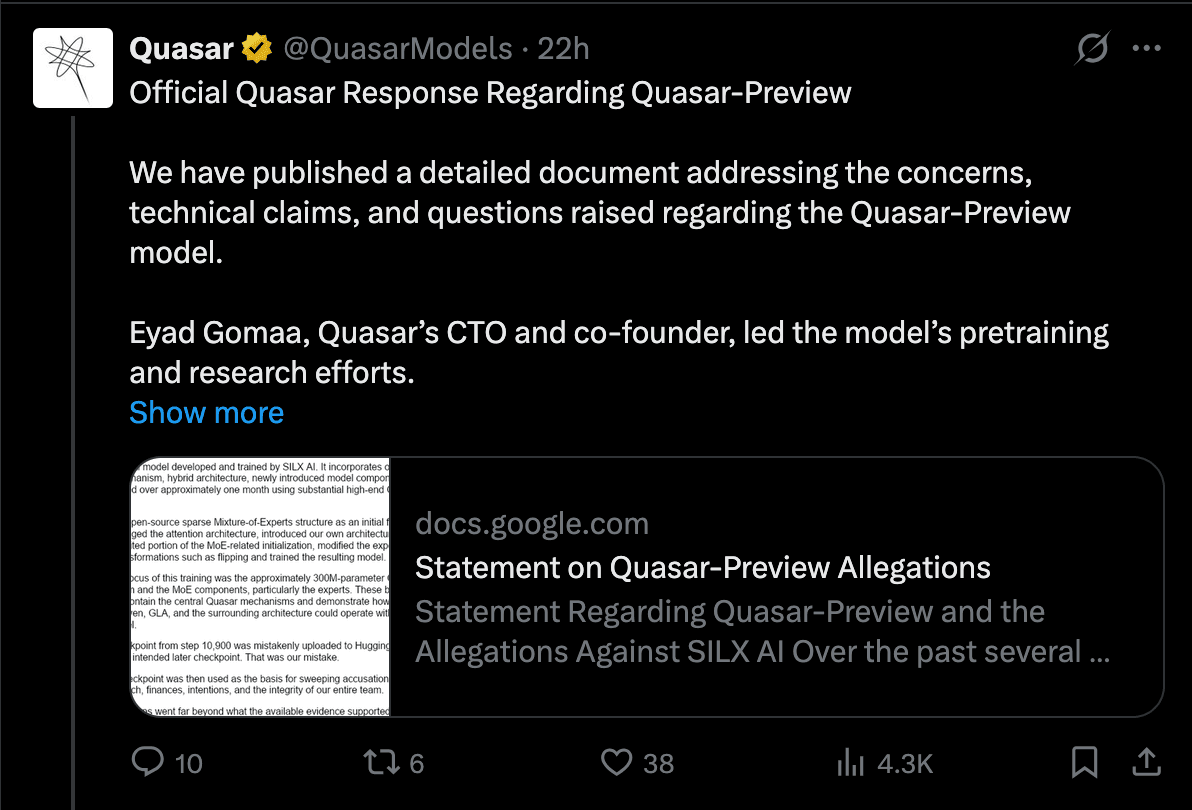
The mistake they admit. They uploaded the wrong file. Their internal work had progressed to training step 230,000, but what went public on Hugging Face was step 10,900 - a very early snapshot. At that stage, most of the inherited material hadn't changed much yet, which is exactly why an audit of it would show near-total similarity to Ling. They point to the commit record on Hugging Face, which does identify the uploaded weights as the step-10,900 checkpoint. They also acknowledge their documentation was inadequate: they should have spelled out clearly which parts came from Ling and which were theirs. They call this a serious failure and take responsibility for it. They also published the later checkpoint publicly, so both files can now be compared.
What they say Quasar actually is. They used Ling's structure as a starting foundation - normal practice in AI - and then added their own attention mechanism, their own architectural paths, and new components, then trained the result. They've published the source code for their attention mechanism separately.
A significant reframe. Their real contribution, they say, was a roughly 300-million-parameter "branch system" designed to act as the model's reasoning core. The rest of the model largely stayed as inherited Ling, affected only to a limited degree.
Read that carefully, because it changes the story regardless of who's right about the fraud question. Both the original audit and the team's own account agree that the newly built portion is about 1.8% of the model. The "18-billion-parameter model trained on Bittensor" framing that the ecosystem repeated for months does not survive either version of events.
On the memory claim. They say 5 million tokens was always described as a target and an experimental configuration, not a finished capability, and that the model's own documentation told readers not to expect mature performance at that length from a preview build.
On blocking miners. The scoring system used a miner's most recent 48 accepted pieces of work, with older contributions gradually dropping out. They say this exists so a miner doesn't lose its whole history if its machines go offline briefly - and that a newcomer finding it hard to compete against established miners with expensive hardware is ordinary market economics, not a hidden rule. The relevant code had been public for months.
On the money. Const (Jacob Steeves) had made $100,000 in credits available on Lium, Bittensor's compute marketplace. Those credits went to renting GPUs, not to anyone's pocket. They also say their AWS bill had passed $14,000, which is why they changed their storage setup - a cost decision, not an attempt to hide anything.
On leaving Bittensor compute. They found an 8-GPU machine on the Bittensor marketplace listed at nearly $60 per hour, versus around $30 per hour for comparable capacity from ordinary providers. At double the price, they moved to a dedicated cluster. Not because the subnet produced nothing, but because it stopped making financial sense.
On the rug pull theory. The subnet keys were held by Const (Jacob Steeves), not by them. They say they repeatedly returned key access rather than keeping it. The relevant tokens were locked on-chain before any of this started. The team doesn't hold tokens from its own subnet, and team mining had only begun a month earlier.
On how it was handled. This is their sharpest complaint. The auditor stated publicly that he chose not to contact the team, because he didn't trust them not to dump. Findings went to Const (Jacob Steeves) and others first. When the team was eventually contacted, members were traveling and speaking from a car. They asked for two days to inspect the checkpoints and reproduce the analysis. They say they were told they had one minute.
Where the defense stands
Parts of it hold up well. The rug pull accusation looks like the weakest of the lot - the custody structure and the on-chain lock both point the same way. The compute economics are credible and checkable. The attribution complaint about a component called Raven appears misdirected, since the team publicly pointed users to the original authors' repository. And when the team published its later checkpoint, a follow-up audit of that file confirmed the previously-untrained portion had since been trained. On that narrow point, they're right.
Other parts are harder. Const (Jacob Steeves) alleges the newly released weights had been deliberately reordered and inverted - which would make a direct file-by-file comparison come out clean while leaving the underlying model unchanged. The team's own statement describes applying "transformations such as flipping" and "provenance-related transformations" to those components, language that is difficult to square with an ordinary training process.
And some things simply weren't answered. The statement addresses one of the two missing features but says nothing about the other. It doesn't address the license mismatch, arguably the most legally concrete issue in the whole affair. And the checkpoint published as proof of good documentation was published with no documentation page at all.
Where things stand
On around August 5, Const (Jacob Steeves) posted a long message in the subnet's Discord. It is the closest thing this affair has to a verdict from the ecosystem's side, and it changed the subnet's economics the same day.
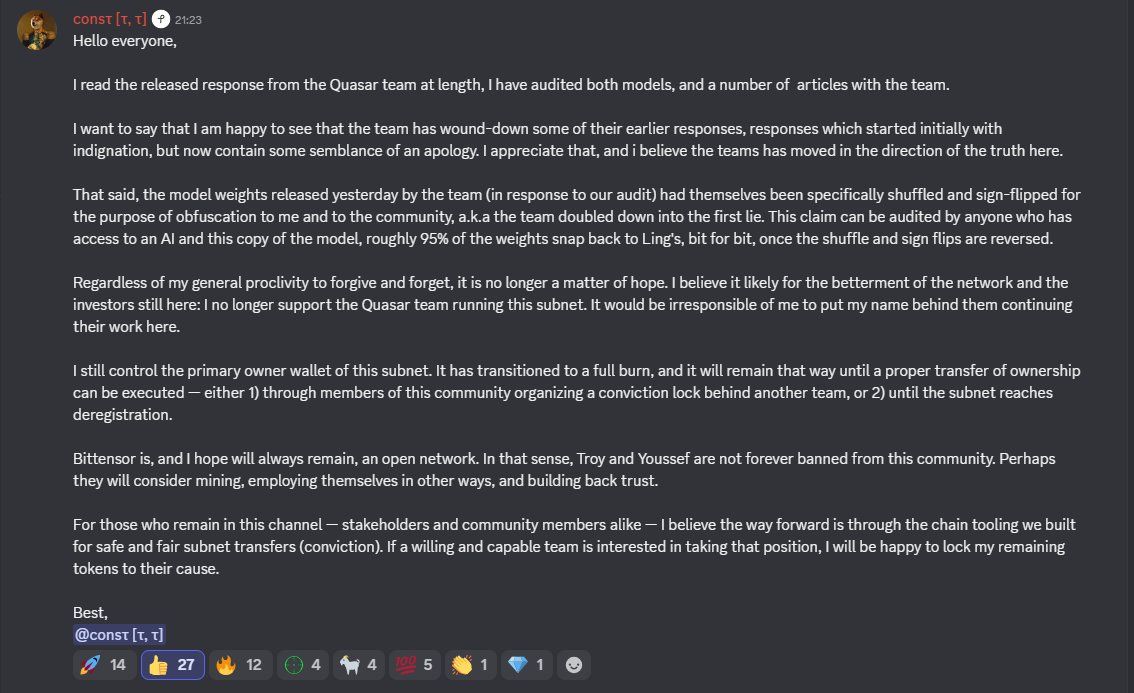
The substance:
- He said the team's tone had moved from indignation toward something closer to an apology, and credited them for that.
- He said he had audited both models and stood by his conclusion.
- He withdrew his support for the team running the subnet.
- He confirmed he still controls the subnet's primary owner wallet, and that it has been switched to a full burn - meaning the owner's share of rewards is being destroyed rather than collected.
- He laid out two paths: either the community organizes behind a new team using Bittensor's Conviction mechanism, or the subnet runs down to deregistration and disappears.
- He said the team members aren't banned from Bittensor and could contribute in other roles, and offered to lock his remaining tokens behind a credible replacement team.
Community reaction to that post was broadly supportive, judging by the reactions on it.
Practically, this means a clock is running. With the owner wallet burning, nothing accumulates. If no capable team steps in, SN24 ends.
As of this writing, no major crypto outlet has covered any of it. The entire affair has played out in Discord, on Hugging Face, and in two GitHub gists.
The lesson that isn't about Quasar
The thing worth taking away has nothing to do with attention mechanisms.
A subnet publicly declined a governance mechanism built specifically to protect holders, on the grounds that a trusted individual's involvement made it unnecessary. Holders accepted that. And when the product turned out not to match its description, there was no protective layer underneath - only a person's judgment, which is not the same thing.
That's the second time in four months that Bittensor holders have absorbed a heavy loss where the underlying issue was governance rather than technology. Whatever the truth about Quasar's weights, that pattern is the more expensive problem.