Why Bittensor Is a Market for Intelligence | Interview Summary
Bittensor co-founder Jacob Steeves, sat down with VirtualBacon for one of the most revealing interviews about the project to date. The conversation went deep into the core thesis behind Bittensor, the breakthrough on Templar (SN3), and how Dynamic TAO reshaped the entire ecosystem from the inside out. Here are the key takeaways.
Why Bittensor Treats Money as an AI Coordination Layer
Jacob Steeves opened the interview with a thesis that sets Bittensor apart from nearly every other crypto project in the space. He argued that money itself is already an optimization algorithm. Economies have been coordinating resources more efficiently than any central planner for centuries. Bittensor takes that same principle and applies it directly to artificial intelligence.
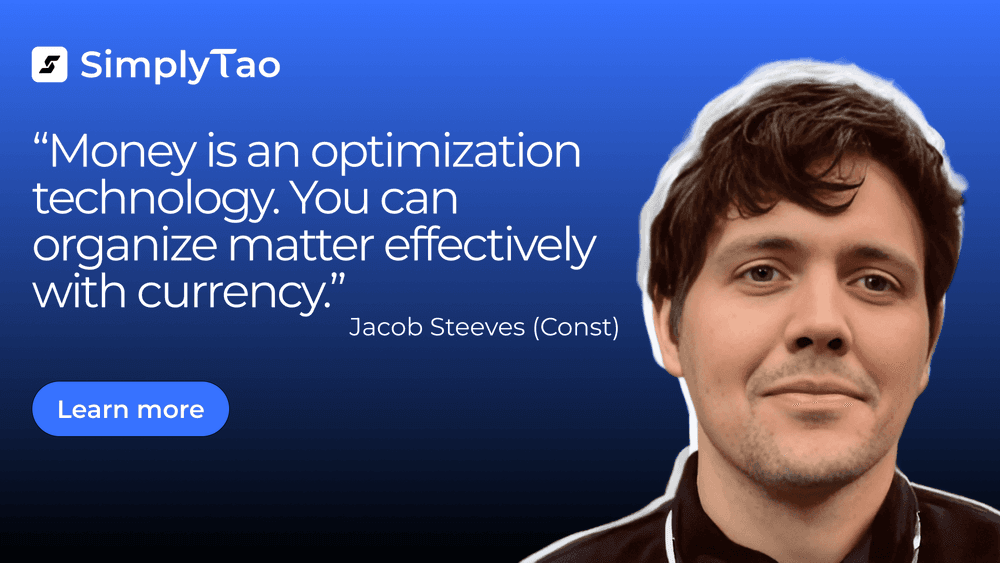
Money is an optimization technology. You can organize matter effectively with currency.
This is a bold claim, but Jacob backed it up by referencing economist Friedrich Hayek and his argument that markets are the most efficient way to aggregate and organize resources at scale. In that reading, money already functions as an algorithm. It solves the coincidence of wants problem and moves goods efficiently. What Bittensor does is extend that logic into the digital world.
Subnets as Markets for Digital Commodities
In this framework, Bittensor subnets function as markets for specific digital goods: inference speed, storage, the value of a gradient to a machine learning model, prediction accuracy, trusted compute, and more. Each subnet creates a two-sided marketplace where validators evaluate miners, filter out the worst performers, and continuously cycle in better ones. The mechanism works almost like a genetic algorithm applied to a real economy.
Throughout the interview, Jacob consistently described Bittensor subnets as markets for digital commodities. Traditional financial infrastructure was never built to price something like the marginal value of a gradient update to a 72 billion parameter model. Bittensor builds these markets from scratch using its core mechanism called Yuma Consensus.
The Machine Learning Analogy
Jacob Steeves then drew an analogy that captures the entire vision in a single sentence. "Machine learning is: define the objective, build a liquid layer underneath it that can adapt, and let the system adapt to the goal. You can define that exact same structure with money." In traditional ML, the liquid layer is a neural network. In Bittensor, that layer is people, capital, compute, and software. The objective function is set by the subnet design. The market does the rest.
In Jacob's framing, Bittensor is less of a blockchain project and more of an economic engine designed to optimize any measurable digital commodity through incentives.
Templar and Covenant 72B: Pricing Gradients on Bittensor
The interview's most detailed technical section focused on Templar (SN3), which positions itself as one of the most ambitious decentralized pre-training efforts to date. Its flagship model, Covenant 72B, is a 72 billion parameter model trained entirely over the internet. This was full pre-training from scratch, worth emphasizing because it is fundamentally harder than the fine-tuning runs that often get attention in the open source AI space.
The challenge goes well beyond simply connecting GPUs over the internet. In a permissionless system where anyone can contribute compute, three problems emerge at once. Participants can submit fake gradients, pretend to do work, or actively try to destroy the training run. There is no central authority to call out bad actors. These are strangers on the internet.
They built a direct market for the value of an update to a model given the current state of the model
- Jacob explained.
How Templar Prices Every Gradient
That sentence carries a lot of weight. Templar does far more than distribute training across nodes. It prices every single contribution. Validators measure how much a given gradient actually reduces the loss of the global model. That measurement becomes the reward. The result is a live, functioning market for the value of machine learning progress. If Bitcoin prices the security of its network, Templar prices the improvement of a model.
On the technical side, the team developed SparseLoCo, a compression and distributed training approach related to the broader LoCo / DiLoCo family. The algorithm has already started spreading beyond Bittensor. Const mentioned recently seeing researchers use it to train models across MacBooks at home, which shows the approach has value well outside the Bittensor context.
Looking ahead, Templar plans to move toward mixtures of experts models. This architecture combines multiple smaller models trained independently into one larger system. Jacob Steeves believes this path can take decentralized training to state-of-the-art scale, potentially matching models like Qwen or DeepSeek in parameter count while keeping the entire process open and permissionless.
How Dynamic TAO Transformed the Bittensor Ecosystem
Before Dynamic TAO, subnet emissions were decided by a small group of validators. Jacob described this bluntly as an oligarchy. It was inefficient and struggled to scale. The real question was: how does a decentralized protocol decide which subnets deserve funding when there is almost nothing on-chain to measure?
The answer was to turn the question itself into a market. Each subnet received its own alpha token, which trades against TAO on a constant-product AMM. The resulting price discovery becomes the protocol's scalable signal for subnet valuation and emission allocation.
We built a commodities market of commodity markets
- Jacob said
Subnets Now Compete for Capital
This is the key insight. Dynamic TAO replaced bureaucratic allocation with a market signal. If a subnet wants to receive TAO emissions, it must attract real demand from real participants. People must buy and hold the alpha token. Outflow counts against the subnet. The mechanism is elegant because it aligns the incentives of builders, investors, and miners all at once.
The behavioral effects were equally striking. After Dynamic TAO launched, every subnet team started competing for global attention. Some launched websites and APIs. Others built Twitter accounts and got on podcasts. A whole new participant class emerged: traders, who now function as a hyperefficient internal evaluation layer across the ecosystem.
What if every single team in Google had a token and a market?
Jacob asked.
You had to go out and sell yourself to the rest of the company.
The comparison is useful because it shows how Bittensor tries to replace managerial allocation with live market pricing. Imagine a corporation where every internal team gets funded based on market demand rather than management decisions. That is essentially what Bittensor built at the protocol level. On the tokenomics side, this mechanism also created a supply shock on TAO itself. Most new emissions flow directly into subnet pools and get locked as liquidity. The effective inflation rate dropped significantly because tokens are sequestered rather than circulating freely.
Bittensor and the Ownership Layer for AI
Jacob closed the interview with what may be his strongest thesis. The future of AI, in his view, centers on ownership, far more than open source code. Open source gives you access to the code. Yet it still leaves you without a stake in the system, a voice in its direction, or a share of its value.
Const was direct about this distinction. He stressed that what Bittensor offers goes beyond open source. In his words, open source is "kind of limited". What Web3 brings to the table is something different entirely: an ownership layer. A system where participants can see, verify, and hold a real stake in the intelligence being produced.
This distinction matters more as AI becomes the dominant force in the global economy. With Bittensor, anyone can buy TAO, stake into subnets, mine, validate, trade, or build. The system is transparent. Contributions are visible, and ownership is real and liquid. As Const put it, by the time most people can buy shares in a company like OpenAI, the value has already been captured by insiders. With Bittensor, participation starts from the ground floor.
The network currently runs dozens of active subnets spanning nearly every vertical in AI, from verifiable inference and trusted execution environments to predictive markets and iterative model improvement. The quality varies, and Const was honest about that. But the system is designed to let the market handle the sorting.
The long-term goal, as Jacob Steeves described it: building the market for intelligence itself.
You can watch the full interview on the VirtualBacon YouTube channel.
Sources:VirtualBacon, Interview with Jacob Steeves (Const), Bittensor Co-Founder, YouTube, 2026.