Bittensor Emission Changes Arrive With the V440 Upgrade
Bittensor has published [release notes for V440], an upgrade that introduces a mechanism called the Emission Gate. The Bittensor emission changes in this release reshape how newly issued TAO reaches subnets, and they favour projects that attract sustained demand from holders. No subnet loses its rewards entirely, yet the distance between the strongest and the weakest projects grows much wider.
How Subnet Emission Worked Before
Until now, emission followed a price proportional rule. Each subnet earned a share of new TAO in direct proportion to the market price of its alpha token. The network treats that price as its signal for demand. That price reflects how TAO holders choose to position their stake, rather than a direct count of users or revenue. A subnet with twice the price of another earned roughly twice the emission. Because the relationship was linear, even a quiet subnet with very little activity still collected a steady trickle of rewards.
That design carried a side effect. Since every registered slot earned something, simply holding a subnet slot became valuable on its own. Registration costs stayed high, and teams often paid for the passive income attached to a slot rather than for the opportunity to build.
What the Bittensor Emission Changes Do
V440 keeps price as the input, then passes it through a threshold. The network calculates a bar, written as theta, from the overall spread of demand across every subnet. A subnet sitting exactly on the bar earns half of what the old rule would have paid it. A subnet slightly above the bar keeps almost all of it. Meanwhile, a subnet far below the bar keeps very little.
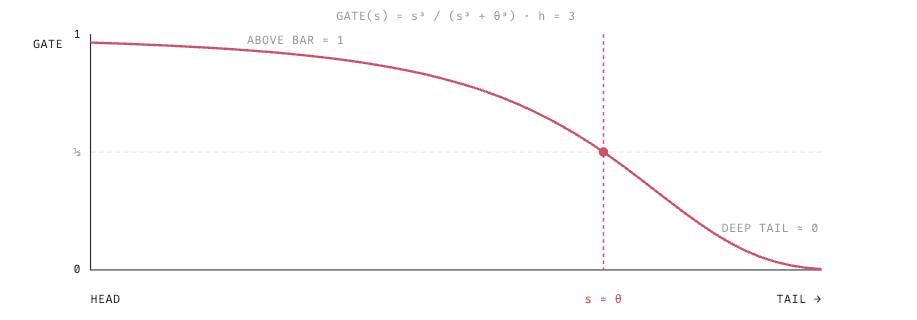
The shape of that curve comes from a Hill function, and two new settings control it. EmissionBarQuantile, set to 0.61, decides how much of total demand sits above the bar and therefore where the bar lands. EmissionGateExponent, set to 3, controls how sharply rewards fall away once a subnet slips below the line. On today's distribution, the bar sits close to rank 32.
Importantly, the bar moves with the market. Bittensor recalculates it once per tempo from the same manipulation resistant moving prices that already drive emission. As a result, a single block of wash trading cannot move it. Registering more subnets does not push the bar higher either, because it depends on how demand spreads rather than on how many slots exist.
The Numbers Behind the Shift
Bittensor modelled the gate against a July 2026 mainnet snapshot of all 128 subnets, treating every subnet as emission enabled. Under the old rule, the 94 subnets below the bar collected 38.4 percent of emission. After the change, that share falls to 12.5 percent. Meanwhile, the top eight subnets rise from 32.8 percent to 52.7 percent.The fall below the bar happens in stages rather than all at once. A subnet just under the threshold keeps roughly 15 to 30 percent of its linear share, while a subnet deep in the tail keeps only 1 to 5 percent.
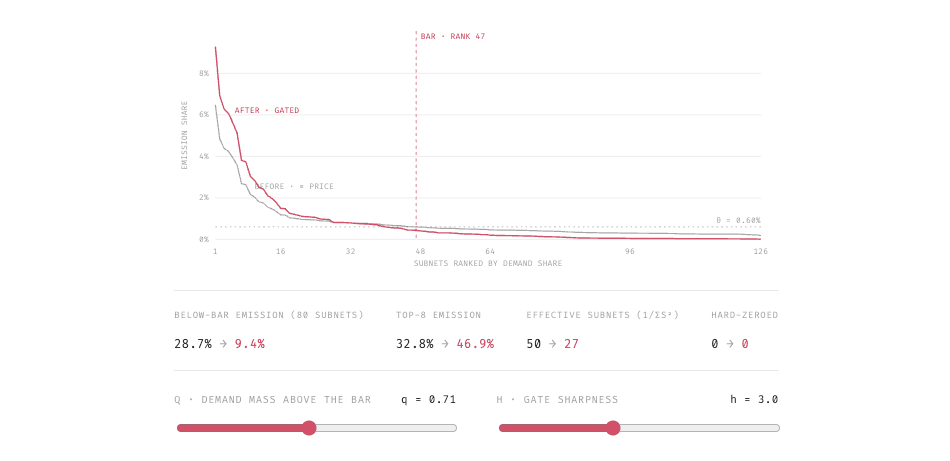
Concentration therefore climbs sharply. The rank at which cumulative emission reaches 80 percent drops from 64 to 23. Meanwhile the effective subnet count falls from roughly 50 to about 22. Even so, the number of subnets cut to zero remains zero.
The incentive near the bar is the most interesting detail. A subnet at rank 36 that grows its demand by 10 percent gains around 26 percent more emission. Growth just below the threshold therefore pays better than growth anywhere else on the network.
What Subnet Owners and Stakers Should Expect
Node operators wait for the on chain spec_version to reach 440, then update to the matching release. Subnet owners above the bar have nothing to adjust, because their emission rises as tail subsidies move toward the head. Owners below the bar retain some emission, although the amount falls sharply with distance from the threshold, and idling stops paying. They can track their position with the btcli subnets bar command.
Stakers face the clearest repricing. Alpha positions in deep tail subnets will earn materially less emission, while positions in leading subnets earn more. Teams waiting to build should benefit, since slot prices lose the passive carry that inflated them. Bittensor expects registration cost to move closer to the plain transaction fee. That remains a forecast, though, rather than a rule written into the code. For now, the network has deferred any increase to the subnet slot cap.
Why This Matters for Bittensor
These Bittensor emission changes turn the network into a stricter market. Previously, mere presence earned a return. Now a subnet must attract more than an average slice of demand before it retains nearly all of its linear share.
The trade off is real. A more concentrated network rewards proven demand, although it also gives new teams a harder climb, and the effective subnet count roughly halves on paper. Bittensor argues that cheaper slots offset this, because a slot becomes a starting position instead of an income stream.
For the wider ecosystem, the message is direct. Subnets that attract sustained demand gain, while those sitting deep in the tail lose most of their passive carry. Bittensor expects lasting demand to follow genuine products and users, even though the protocol itself reads price rather than usage. Whether that pressure produces stronger projects or simply a smaller field is the question the next few months will answer.
Frequently asked questions
What is the Bittensor V440 upgrade?
A network upgrade that changes how the chain shares newly issued TAO between subnets. It adds a demand threshold called the Emission Gate.
What is the Emission Gate?
A filter between a subnet's demand score and its emission. Above the bar a subnet keeps almost everything, below it the payout drops away fast.
How did emission work before?
It was price proportional. Twice the alpha token price meant roughly twice the emission, so even a quiet subnet still earned a trickle.
Will any subnet drop to zero?
No. Just below the bar a subnet keeps 15 to 30 percent of its linear share, and deep in the tail 1 to 5 percent.
What do the Bittensor emission changes mean for stakers?
The Bittensor emission changes hit deep tail alpha hardest, while the head earns more. The top eight subnets move from 32.8 to 52.7 percent of emission.
Will launching a subnet get cheaper?
Bittensor expects registration cost to fall toward the transaction fee, since a slot no longer carries passive income. Bittensor has also deferred the slot cap increase.