Teutonic-I (SN3): The New King of Decentralized AI | Bittensor
On August 1, 2026, a model with 10 billion parameters finished ahead of a rival seven times its size. Teutonic-I averaged 62.28% across eleven public benchmarks, while Covenant-72B managed 57.55%.
The method behind that number is the real story. No lab planned this model, no team followed a training recipe, and no cluster ran a coordinated job. Teutonic-I emerged from 70 days of open competition on Bittensor SN3, where independent miners spent ten weeks trying to beat whoever held the lead.
What Happened on SN3

The contest ran from June 2 to August 10, 2026 with one objective: pretrain the strongest model the network could produce. Pretraining is the first and most expensive stage of building a language model, the stage where it learns general patterns from enormous amounts of text.
Miners fought 2,163 duels over those ten weeks, and 203 of them ended with a new leader taking over. The best version of all, king number 191, appeared on August 1, sixty days into the competition. A checkpoint, in this context, means a saved copy of a model at one moment in its training.
How the King of the Hill Mechanism Works
The subnet always recognises one official best model, called the king. Any miner can download it, train a rival on the same architecture, and challenge for the throne.
Three rules bind everyone: the architecture, the way evaluation data gets selected, and the margin a challenger has to clear. The miner controls everything else, including the training script, the datasets, the hardware, the budget and the hours spent. Two competitors can take opposite approaches to the same problem, and the network still judges both on identical evidence.
That design separates SN3 from ordinary distributed training, where thousands of machines compute one gradient step together and average the results. Here every miner trains alone, and quality improves through selection. Think of it as evolution under a brutal filter, where effort earns nothing and only measurable improvement survives.
The Test a Challenger Has to Pass
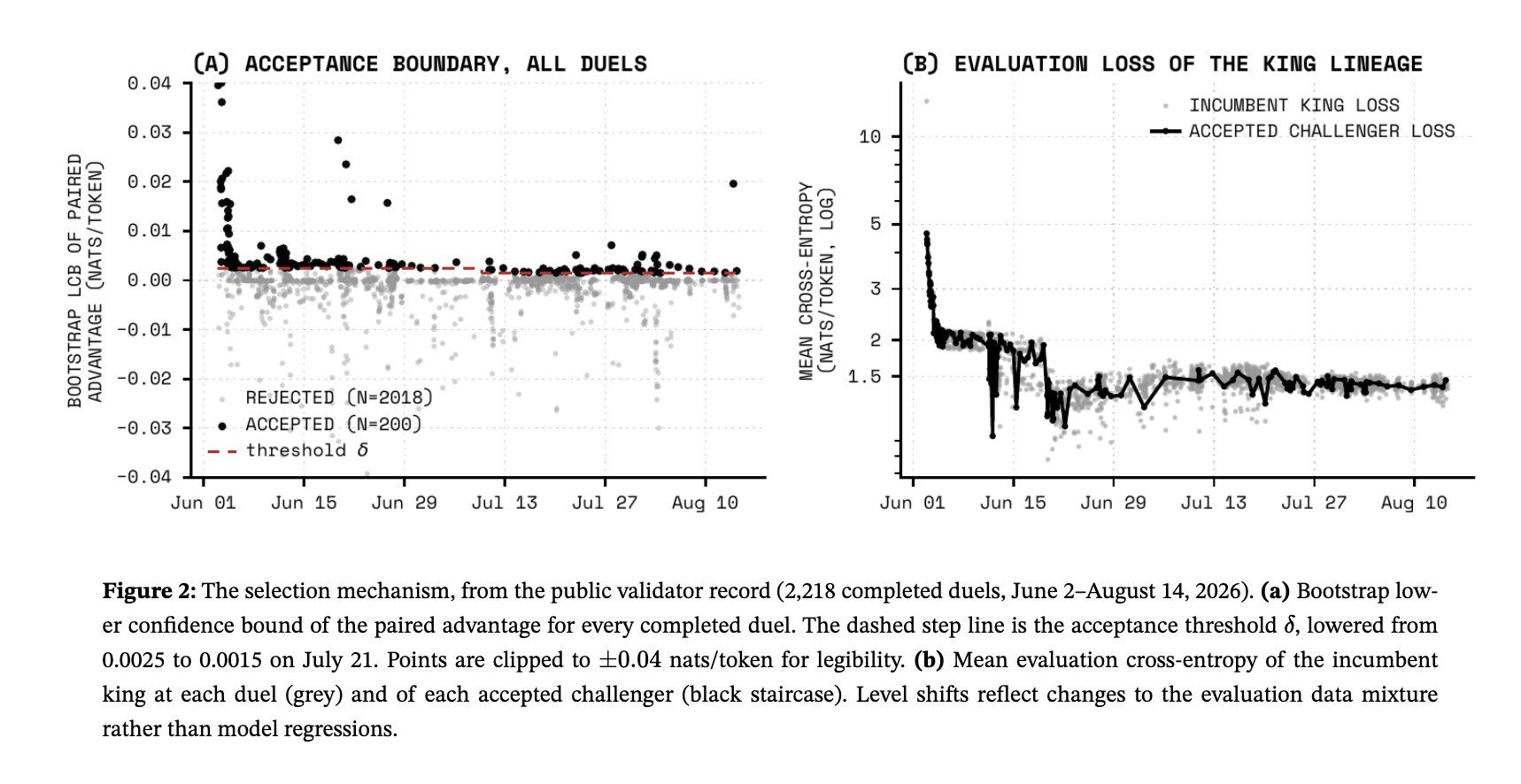
King and challenger sit the same exam. Both read identical text sequences of 2,048 tokens, and tokens are the small chunks of text a model reads, roughly three quarters of a word each. The subnet derives that test set algorithmically from the hash of the submission block, which stops miners from lining up friendly material in advance.
For every sequence, the evaluator measures loss, a score of how accurately a model predicts the next token, where lower is better. A slightly better average still leaves the challenger outside the throne room. The subnet resamples the results 10,000 times to see how stable that lead really is, then judges the challenger on a conservative lower bound instead of the raw average. Only a large and statistically solid advantage moves the crown.
Direction still comes from the top. Over the competition, the organisers issued 16 hyperparameter updates and rebalanced the dataset mixture 15 times, drawing evaluation samples from 12 datasets that hold more than 4 trillion tokens between them. The effect appeared immediately. In the first week alone, the average benchmark score climbed from 30.56 to 56.48, which accounts for most of the total gain across the whole contest. Attention shifted toward mathematics and reasoning in late June, and by July the model settled onto a plateau around 61 to 62 points.
How Teutonic-I Compares With Larger Models
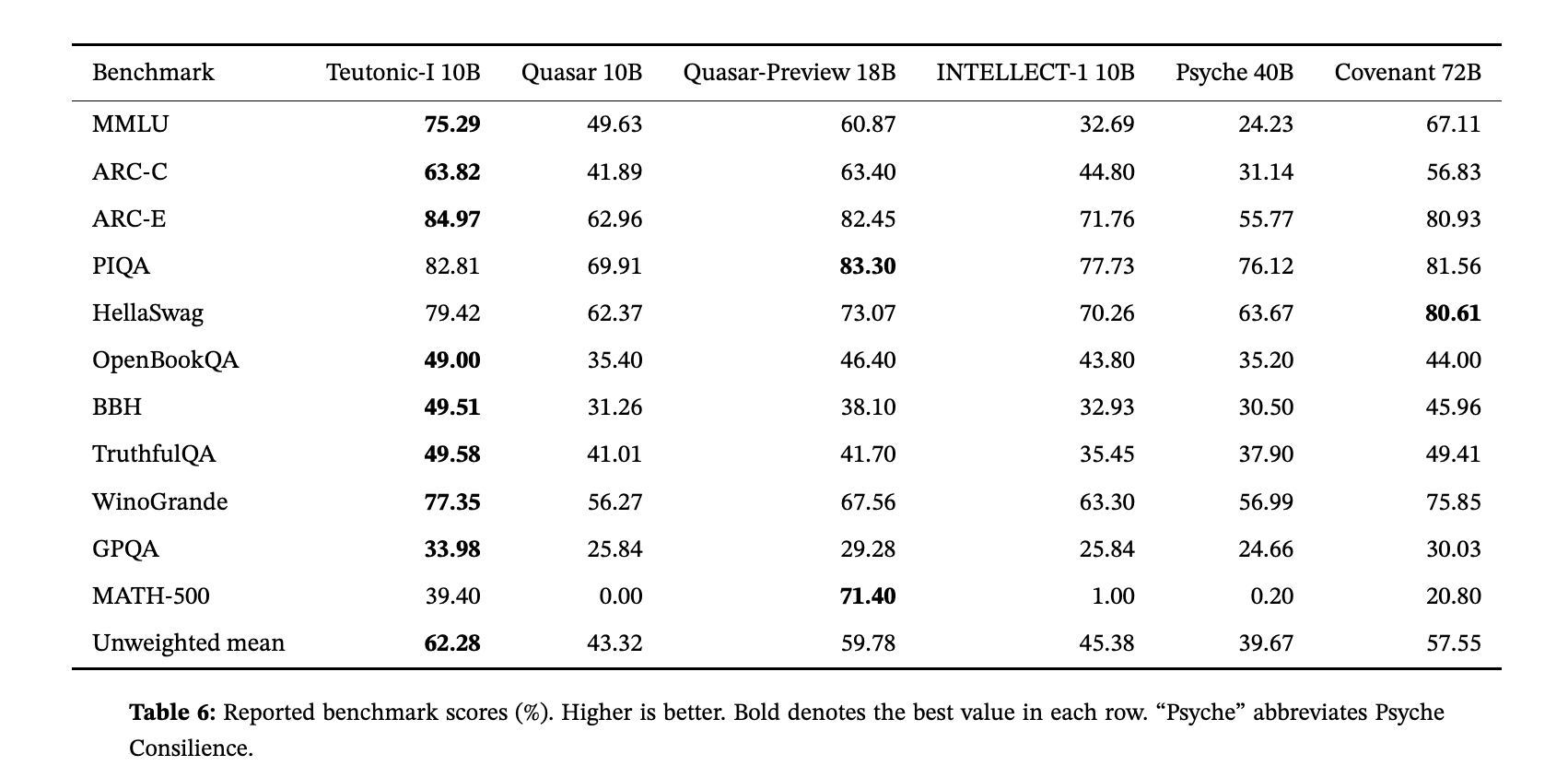
Across the eleven shared benchmarks, Teutonic-I averaged 62.28%. Quasar-Preview 18B came closest at 59.78%, followed by Covenant-72B at 57.55%, INTELLECT-1 10B at 45.38% and Psyche Consilience 40B at 39.67%.
The 10B model took first place on 8 of the 11 tests. Its strongest showing came on MMLU at 75.29%, more than eight percentage points clear of Covenant-72B, and it also led on BBH, GPQA and both ARC variants. Quasar-Preview held a narrow lead on PIQA, Covenant kept HellaSwag, and MATH-500 remains the clearest weak spot. On the harder MMLU-Pro benchmark, Teutonic-I reached 39.84% against 33.20% for Quasar-Preview.
How Miners Get Paid
Rewards follow the throne. The validator splits emissions between the current king and up to four previous kings, giving each an equal 20% share and renormalising when an older king leaves the network. A winner therefore keeps earning through the next four dethronements, which takes the edge off a winner takes all race while preserving the pressure to improve. Payment depends on verified model improvement, rather than on claimed GPU hours or processed tokens.
Why Teutonic-I Matters for Bittensor
This is strong evidence that serious work gets done on Bittensor. A crowd of independent miners, competing for token rewards under a transparent statistical rule, produced a model that beats far larger centralised efforts. The incentive design handled the coordination that a traditional lab would normally buy with project managers, fixed recipes and a single budget.
SN3 belongs to Jacob Steeves, known as Const, the co-founder of Bittensor, and a three person team from Dendrite helped him build the system behind this competition: ch4ris4rd, hux_dendrite and tony_dendrite. Const has already named the next target: a similar competition for models approaching 100 billion parameters. If the mechanism holds at that scale, the distance between decentralised training and the established labs gets considerably more interesting.
Sources: https://teutonic.ai/paper.html https://blog.teutonic.ai/ https://x.com/ch4ris4rd/status/2088351435347878388