Covenant AI Exits Bittensor: Full Breakdown of What Happened
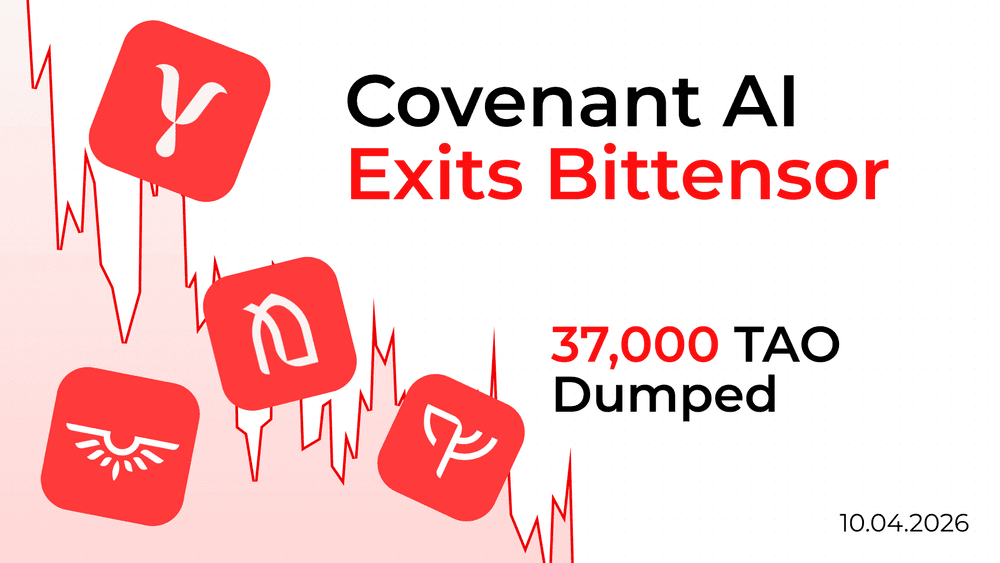
On April 10, 2026, Covenant AI founder Sam Dare published a statement announcing his team's departure from the Bittensor network. Within hours, Dare sold approximately 37,000 TAO worth of subnet alpha tokens across all three of his subnets. Consequently, TAO crashed more than 15%, falling from roughly $337 to $284, according to CoinMarketCap data. The departure left Bittensor's most celebrated achievement without the team that built it.
This is what happened, why it matters, and what comes next for the Covenant Bittensor story that shook the entire ecosystem.
Why Covenant AI Matters to Bittensor
Covenant AI is the organization founded by Sam Dare that operated three interconnected subnets on Bittensor. Templar (SN3) handled decentralized large language model pre-training. Basilica (SN39) served as a decentralized compute marketplace for GPU resources. Grail (SN81) focused on post-training tasks like reinforcement learning and model evaluation.
Together, these three subnets formed a vertically integrated decentralized AI lab. In fact, their flagship achievement was Covenant-72B. This 72 billion parameter large language model was trained entirely through permissionless, decentralized coordination. More than 70 independent contributors participated using commodity GPUs and standard home internet connections. As a result, the model scored 67.1 on the MMLU benchmark. That placed it in competitive range with Meta's LLaMA-2-70B.
The Covenant-72B announcement on March 10, 2026 triggered a massive rally. TAO surged roughly 90% throughout March, according to CoinMarketCap. Subnet alpha tokens posted amplified gains of up to 400%. The Templar subnet token alone jumped 194% in seven days. As a result, the combined market cap of all Bittensor ecosystem tokens reached approximately $1.5 billion.
Momentum accelerated further when Nvidia CEO Jensen Huang referenced the achievement on the All-In Podcast on March 20. He called Bittensor's approach "a modern version of Folding@home." Days earlier, Jack Clark, co-founder of Anthropic, highlighted the breakthrough in his Import AI newsletter. He described it as a development worth ongoing monitoring. These endorsements pushed AI tokens up more than 40% in a single day. Above all, they gave Bittensor mainstream credibility it had never achieved before.
All of this context is essential to understanding the scale of the Covenant Bittensor crisis that unfolded on April 10.
The Covenant Bittensor Conflict: What Led to the Split
In his public statement on X, Sam Dare accused Jacob Steeves, known across the ecosystem as Const, of exercising centralized control over the network. Samuel Dare described a series of actions taken against Covenant AI in recent weeks. Specifically, he characterized them as punitive and incompatible with the principles Bittensor claims to uphold.
The specific allegations are serious. First, they include the suspension of emissions to Covenant's subnets and the removal of moderation capabilities over Covenant's own Discord channels. Samuel Dare also pointed to the unilateral deprecation of Covenant's subnet infrastructure. Finally, he cited direct economic pressure through large token sales timed to moments of operational conflict.
Covenant Founder also challenged the entire governance structure of Bittensor. He described the network's triumvirate system, where three individuals manage the multisig for upgrades, as "decentralization theatre." In his words, Const "maintains effective control over the triumvirate" and "deploys changes unilaterally whenever he chooses."
It is worth noting that Const officially stepped down as CEO of the Opentensor Foundation in February 2026. Co-founder Ala Shaabana stepped down alongside him. At the time, many observers interpreted the move as a genuine step toward decentralization. Indeed, Const said publicly he would remain active in development, but without formal legal authority. Dare's allegations directly challenge whether that transition changed anything in practice. Learn more about it here.
The Token Dump That Shook the Covenant Bittensor Ecosystem
What turned the departure announcement into a full-blown crisis was the token sale. Sam Dare sold approximately 37,000 TAO worth of subnet alpha tokens across Templar (SN3), Basilica (SN39), and Grail (SN81). On-chain data confirmed the sales. As a consequence, the impact was immediate.
TAO dropped from approximately $337 to $284 within hours, based on CoinMarketCap price data. In other words, that represents a decline of more than 15%. At its lowest point, TAO touched $262.51 before partially recovering. Trading volume surged by 156% as investors rushed to exit positions. Subsequently, the crash erased a significant portion of the March rally. That rally drew its momentum from Covenant's own achievement.
Prominent Bittensor community figure Dread Bongo, posted his own commentary sharply criticizing the decision. He described the token sale as what appeared to be "a rug for max extraction." He expressed deep disappointment, noting that Templar had achieved the largest public exposure of any subnet to date. His core argument was clear. In his view, dumping the tokens destroyed the investments of everyone who had supported these subnets. Therefore, expecting those same people to follow the team elsewhere was unrealistic.
How Const Responded to the Covenant Bittensor Departure
Const responded within hours on both X and the Bittensor Discord. Notably, he did not take a defensive posture on the centralization accusations. Instead, he framed the situation as an opportunity to advance Bittensor's governance.
On X, Const proposed "lock-based subnet ownership." Under this model, ownership of a subnet would be tied to a team's long-term economic commitment. Investors would see in advance if an owner unlocked their tokens. As a result, they could reprice the subnet before the owner acts. They could also redirect their stake to another team or agent. Const framed the event positively. He thanked Sam Dare for "helping further Bittensor's decentralization" and for exposing "one of crypto's oldest problems: founders who rug their token holders."
On Discord, Const addressed the communities of all three Covenant subnets directly. He referenced an original plan from the launch of dTAO a year earlier. That plan involved community-owned vote-based ownership, where alpha holders could vote to elect the team that sets hyper-parameters. He suggested this is now the moment to begin that conversation again.
Const also made his personal position clear. He stated that "Sam has clearly made an ugly decision out of malice and greed." However, he added that "these types of moments are in fact openings." He described the situation as an opening for a new chapter in what subnets can be and who runs them.
In a follow-up post on X, Const addressed each of Samuel Dare specific claims directly. Importantly, his responses offer a sharply different account of the events that led to the split.
On the allegation that he suspended emissions to Covenant's subnets, Const stated he does not have the ability to suspend emissions. Instead, he explained that he sold some of his alpha holdings on Dare's three subnets because they were not running and were on what he described as "near 100% burn code." He pointed out that this changed the emission the same way all buys and sells on Bittensor do. He emphasized that he does not hold any privilege beyond what normal TAO holders have.
On the claim that he deprecated Covenant's channels and removed moderation rights, Const said that Sam Dare himself deprecated his own channels. According to Const, Dare did this via a pinned comment and also a post on X. The channels in question were Discord channels.
On the allegation about removing moderation capabilities, Const provided additional context. According to his account, Dare had been deleting posts in his channel that contained genuine, honest criticism from community members. Const stated that he removed that ability temporarily and then reinstated it later. He clarified that he did not remove Dare's moderator role entirely. He simply stopped Dare from deleting posts from others.
On the claim about "deprecating infrastructure" Const said he was unsure what Dare meant by this.
On the allegation of large, visible token sales designed to apply economic pressure, Const pushed back directly. He described his sales as representing less than 1% of what he had invested in Dare's teams. In addition, he acknowledged that visibility is impossible to avoid given his position. Const also stated that he reserves his right to buy and sell tokens, as that right is what underpins the entire dTAO system.
Both accounts remain active claims from the two parties involved. The community continues to assess the situation based on on-chain data and the public record.
What Happens Next for the Three Subnets
The most immediate question is the fate of the three subnets. Templar (SN3), Basilica (SN39), and Grail (SN81) represent real infrastructure and real research capabilities. The miners and validators who contributed compute now face uncertainty. So do the investors who staked TAO into these subnets. Const signaled his intent to support a community-driven process for finding new operators. However, specific details remain unclear.
Furthermore, Const confirmed he is one of the largest holders and technical contributors to all three projects. He said he would participate in any new governance mechanism. The proposed vote-based ownership model could allow alpha holders to elect new leadership. That would be a first in Bittensor's history.
The dTAO Vulnerability and Lock-Based Ownership
Dare's token sale exposed a structural vulnerability in the dTAO system. Subnet owners hold significant economic positions in their own subnets. When an owner exits by dumping those tokens, it creates cascading losses for everyone else staked there. The lock-based ownership concept Const proposed is a direct response. If implemented, it would let the market see and react to an owner's commitment level before damage occurs.
What This Means for the Broader Covenant Bittensor Debate
The governance debate Dare raised is not new. However, it has never been this public or this consequential. Bittensor has faced criticism about centralization for years. The protocol has taken concrete steps to address it. Those include the dTAO upgrade in February 2025 and the Opentensor leadership transition in February 2026. Whether those steps went far enough is now an open question in the broader crypto market.
For the broader market, this event is a stress test. After all, TAO had just completed a historic rally. That rally drew from genuine technical milestones and endorsements from Jensen Huang and Jack Clark. The key question now is whether those fundamentals survive the departure of the team that demonstrated them.
Meanwhile, Covenant AI stated it plans to continue decentralized AI training outside of Bittensor. The team promised forthcoming announcements about new projects. Dare emphasized that the research, the team, and the models travel with them.
Bittensor still continues to operate 128 active subnets with plans to expand to 256 later in 2026. The Grayscale Bittensor Trust remains active. A potential conversion to a spot TAO ETF is still under discussion. The network has survived major disruptions before. Whether it emerges stronger from this one depends on how quickly the community stabilizes the affected subnets and how fast the proposed governance upgrades move from concept to reality.